Zvi Maoz (Area A, area kuil) dan Vassilios Tzaferis (Area B, area pusat sipil)[1]
Aksesumum
ya (taman nasional)
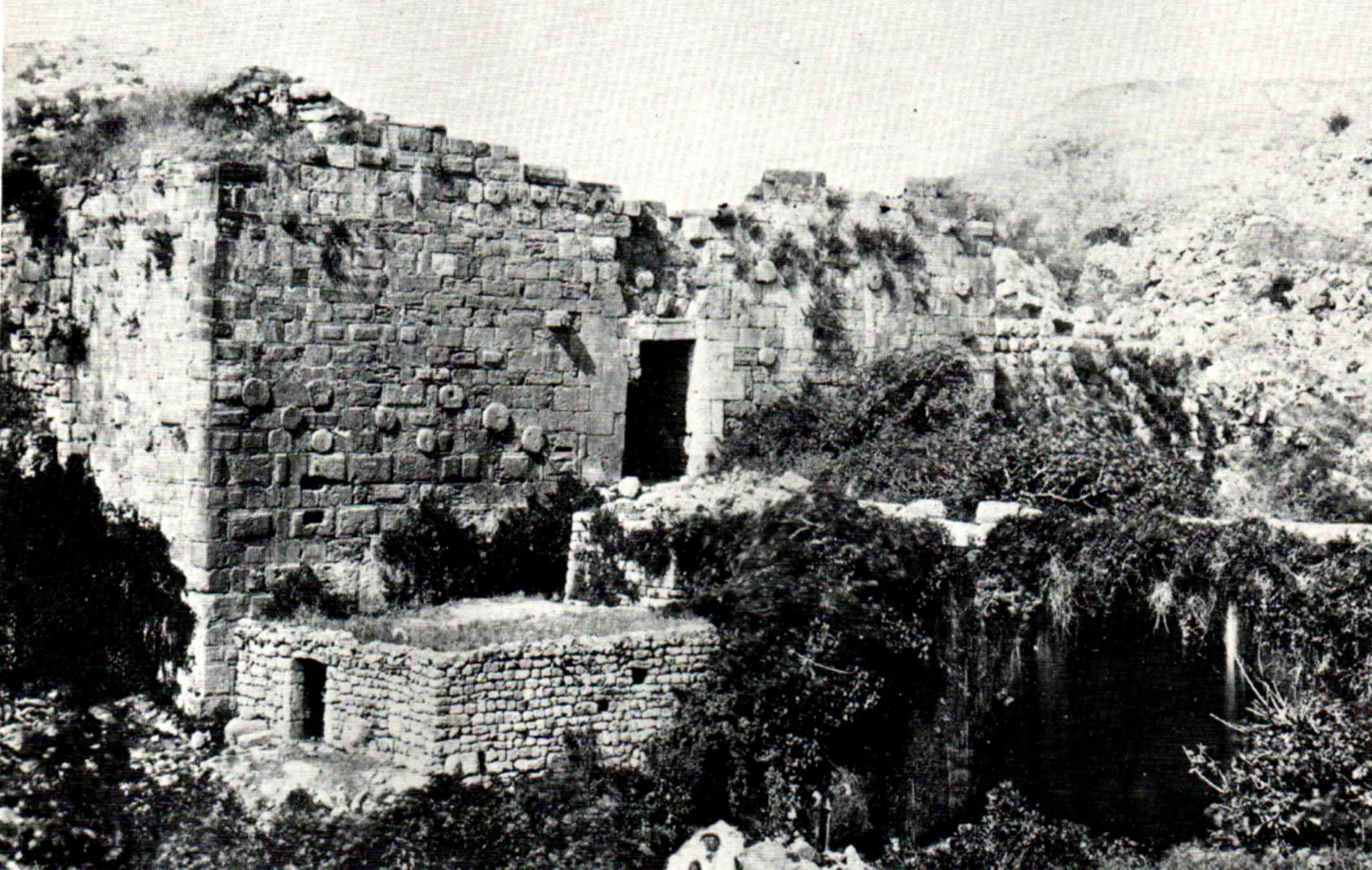
Banias (Arab: بانياس الحولةcode: ar is deprecated ; Modern Hebrew: בניאסcode: he is deprecated ; Judeo-Aramaic, Medieval Hebrew: פמייסcode: sem is deprecated , dll.;[2]Yunani Kuno: Πανεάςcode: grc is deprecated ), juga dieja Banyas, adalah sebuah situs di Dataran Tinggi Golan dekat mata air alami, yang dulunya dikaitkan dengan dewa Yunani Pan. Situs ini telah dihuni selama 2.000 tahun, hingga penduduk Suriahnya mengungsi dan rumah-rumah mereka dihancurkan oleh Israel setelah Perang Enam Hari tahun 1967.[3] Terletak di kaki Gunung Hermon, di sebelah utara Dataran Tinggi Golan, Gaulanitis klasik,[4] di wilayah yang diduduki Israel, mata air ini merupakan sumber Sungai Banias, salah satu anak sungai utama Sungai Yordan. Para arkeolog menemukan sebuah kuil yang didedikasikan untuk Pan dan dewa-dewa terkait, serta reruntuhan kota kuno yang berasal dari periode Helenistik dan Romawi.
Herodes Agung, raja Yudea, membangun sebuah kuil yang didedikasikan untuk Augustus di lokasi tersebut.[4] Selanjutnya, putra Herodes, Filipus sang Tetrark, mengembangkan daerah tersebut lebih lanjut, mendirikan sebuah kota. Pada tahun 61 M, Agrippa II memperluas dan mengganti nama kota tersebut menjadi Neronias Irenopolis.[4] Kota kuno itu disebutkan dalam InjilMatius dan Markus, dengan nama Kaisarea Filipi, sebagai tempat di mana Yesus menegaskan pengakuan Petrus bahwa Yesus adalah Mesias;[5] Saat ini, situs tersebut menjadi tempat ziarah bagi umat Kristen.[6]
Mata air di Banias awalnya berasal dari sebuah gua besar yang diukir di tebing curam yang secara bertahap dilapisi dengan serangkaian kuil. Temenos (kawasan suci) pada tahap akhirnya mencakup sebuah kuil yang terletak di mulut gua, halaman untuk ritual, dan ceruk untuk patung-patung. Kuil ini dibangun di atas teras alami yang tinggi sepanjang 80 meter di sepanjang tebing yang menjulang di atas bagian utara kota. Sebuah prasasti empat baris di dasar salah satu ceruk berkaitan dengan Pan dan Echo, peri gunung, dan bertanggal 87 SM.
Mata air yang dulunya sangat besar itu menyembur dari gua batu kapur, tetapi gempa bumi memindahkannya ke kaki teras alami tempat ia sekarang merembes dengan tenang dari batuan dasar, dengan aliran yang jauh berkurang. Dari sini, aliran air, yang disebut Nahal Hermon dalam bahasa Ibrani, mengalir menuju tempat yang dulunya merupakan rawa-rawa Hula yang dipenuhi malaria.[7]
Etimologi
Kota kuno ini pertama kali disebutkan dalam konteks Pertempuran Panium, yang terjadi sekitar tahun 200–198 SM, ketika nama wilayah tersebut diberikan sebagai Panioncode: grc is deprecated . Kemudian, Pliny menyebut kota itu Paneascode: grc is deprecated (Yunani Kuno: Πανειάςcode: grc is deprecated ). Kedua nama tersebut berasal dari nama Pan, dewa alam liar dan pendamping para nimfa.[8] Dalam penggunaan bahasa Arab selanjutnya, nama tempat tersebut menjadi Bāniyās (بانياس), umumnya dijelaskan sebagai adaptasi fonologis dari bahasa Yunani Paneas di mana bunyi /p/ di awal kata bergeser menjadi /b/ karena /p/ bukan merupakan bunyi asli dalam fonologi bahasa Arab. Kesinambungan nama di berbagai periode diperkuat oleh peran administratif situs tersebut yang telah lama ada di wilayah tersebut dan oleh kelangsungan tradisi toponimik lokal terkait dalam sumber-sumber selanjutnya.[9]
↑"How modern disputes have reshaped the ancient city of Banias". Aeon. In June 1967, the penultimate day of the Six Day War saw Israeli tanks storm into Banias in breach of a UN ceasefire accepted by Syria hours earlier. The Israeli general Moshe Dayan had decided to act unilaterally and take the Golan. The Arab villagers fled to the Syrian Druze village of Majdal Shams higher up the mountain, where they waited. After seven weeks, abandoning hope of return, they dispersed east into Syria. Israeli bulldozers razed their homes to the ground a few months later, bringing to an end two millennia of life in Banias. Only the mosque, the church and the shrines were spared, along with the Ottoman house of the shaykh perched high atop its Roman foundations.
123Rogers, Guy MacLean (2021). For the Freedom of Zion: the Great Revolt of Jews against Romans, 66-74 CE. New Haven: Yale University Press. hlm.535. ISBN978-0-300-24813-5.
↑Amir, D. (1968). Banias–From Ancient to Modern Times: Introduction to the Geography and Natural History of the Area (dalam bahasa Ibrani). Kibbutz Dan: Kibbutz Dan.
↑Marom, Roy; Kharanbeh, Saleh (2025). "An Analysis of Selected Toponymic Survivals in the Northern Hula Valley". Israel Exploration Journal. 75 (2). Jerusalem: Israel Exploration Society: 111.
Bibliografi
al-Athīr, ʻIzz al-Dīn Ibn (Translated 2006) The Chronicle of Ibn Al-Athīr for the Crusading Period from Al-Kāmil Fīʼl-taʼrīkh: The Years AH 491-541/1097-1146, the Coming of the Franks And the Muslim Response Translated by Donald Sidney Richards Ashgate Publishing, Ltd. ISBN0-7546-4078-7
Berlin, A.M. (1999). "The Archaeology of Ritual: The Sanctuary of Pan at Banias/Caesrae Philippi". Bulletin of the American Schools of Oriental Research (315: 27–45): 27–45. doi:10.2307/1357531. JSTOR1357531. S2CID163379333.
Friedland, Elise A., "Roman Marble Sculpture from the Levant: The Group from the Sanctuary of Pan at Caesarea Philippi (Panias).” PhD Dissertation (University of Michigan 1997).
Fulton, Michael S. (2018). Artillery in the Era of the Crusades: Siege Warfare and the Development of Trebuchet Technology. BRILL. ISBN9789004376922.
Gammer, Moshe; Kostiner, Joseph; Shemesh, Moshe (2003). Political Thought and Political History: Studies in Memory of Elie Kedourie. Routledge. ISBN0-7146-5296-2.
Jackson, Peter (2007). "The Crusades of 1239–41 and their aftermath". Dalam Hawting, Gerald R. (ed.). Muslims, Mongols and Crusaders: An Anthology of Articles. Routledge. ISBN978-0-203-64182-8.
Ma‘oz, Z.-U. ed., Excavations in the Sanctuary of Pan at Caesarea Philippi-Baniyas, 1988-1993 (Jerusalem, forthcoming).
Ma‘oz, Z.-U., Baniyas: The Roman Temples (Qazrin: Archaostyle, 2009).
Ma‘oz, Z.-U., Baniyas in the Greco-Roman Period: A History Based on the Excavations (Qazrin: Archaostyle, 2007).
Ma‘oz, Z.-U., V. Tzaferis, and M. Hartal, “Banias,” in The New Encyclopedia of Archaeological Excavations in the Holy Land 1 and 5 (Jerusalem 1993 and 2008), 136-143, 1587-1594.
MacMillan, M. (2001). Peacemakers: The Paris Conference of 1919 and Its Attempt to End War. J. Murray. ISBN0-7195-5939-1.
Smithline, Howard (2006-02-01). "Banias" (118). Hadashot Arkheologiyot – Excavations and Surveys in Israel.
Tzaferis, V., and S. Israeli, Paneas, Volume I: The Roman to Early Islamic Periods, Excavations in Areas A, B, E, F, G, and H (IAA Reports 37, Jerusalem 2008).