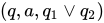
For an existential transition , the automaton A nondeterministically chooses to switch the state to either or , upon reading a. Thus, behaving like a regular nondeterministic finite automaton.
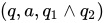
For a universal transition , the automaton A moves to and, upon reading a, simulating the behavior of a parallel machine.
Note that due to the universal quantification a run is represented by a run tree. A accepts a wordw, if there exists a run tree on w such that every path ends in an accepting state.
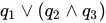
An alternative model that is frequently used is the one where Boolean combinations are in disjunctive normal form so that, e.g., would represent . The state tt (true) is represented by in this case and ff (false) by . This representation is usually more efficient.
Even though AFA can accept exactly the regular languages, they are different from other types of finite automata in the succinctness of description, measured by the number of their states.
Chandra et al.[1] proved that converting an -state AFA to an equivalent DFA
requires states in the worst case, though a DFA for the reverse language can be constructued with only states. Another construction by Fellah, Jürgensen and Yu.[2] converts an AFA with states to a nondeterministic finite automaton (NFA) with up to states by performing a similar kind of powerset construction as used for the transformation of an NFA to a DFA.
Computational complexity
The membership problem asks, given an AFA and a word, whether accepts . This problem is P-complete.[3] This is true even on a singleton alphabet, i.e., when the automaton accepts a unary language.
The non-emptiness problem (is the language of an input AFA non-empty?), the universality problem (is the complement of the language of an input AFA empty?), and the equivalence problem (do two input AFAs recognize the same language) are PSPACE-complete for AFAs[3]:Theorems 23,24,25.