Design parameters
The aim of a high-speed flash is to be very fast and yet bright enough for adequate exposure. An air-gap flash system typically consists of a capacitor that is discharged through a gas (air in this case). The speed of a flash is mainly determined by the time it takes to discharge the capacitor through the gas. This time is proportional to
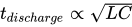 ,
,
in which L is the inductance and C the capacitance of the system. To be fast, both L and C must be kept small.
The brightness of the flash is proportional to the energy stored in the capacitor:
 ,
,
where V is the voltage across the capacitor. This shows that high brightness calls for a large capacitance and a high voltage. However, since a large capacitance would have a relatively long discharge time that would make the flash slow, the only practical solution is to use a very high voltage on a relatively small capacitor, with a very low inductance. Typical values are 0.05 µF capacitance, 0.02 µH inductance, 10 J energy, 0.5 µs duration and about 20 MW power.[2]
Air (mainly nitrogen) is preferred as a gas because it is fast. Although xenon has a much higher efficiency in converting energy into light, xenon (because of its afterglow) cannot achieve a flash pulse duration less than about 10 microseconds.
The spark is guided over a quartz surface to improve the light output and benefit from the cooling capacity, making the flash faster.[3][4] This has a negative effect in the form of quartz erosion because of high energy discharge.


.JPG)


