6181 Bobweber, provisional designation 1986 RW, is a stony asteroid from the inner regions of the asteroid belt, approximately 5 kilometers in diameter. It was discovered on 6 September 1986, by American astronomer Eleanor Helin at the U.S. Palomar Observatory in California, and named after astronomer Robert Weber.[2]
Orbit and classification
The S-type asteroid orbits the Sun in the inner main-belt at a distance of 1.9–3.0AU once every 3 years and 9 months (1,384 days). Its orbit has an eccentricity of 0.24 and an inclination of 8° with respect to the ecliptic.[1] The first precovery was taken at the discovering observatory in 1954, which extended the asteroid's observation arc by 32 years prior to its discovery observation.[2]
Physical characteristics
Rotation period
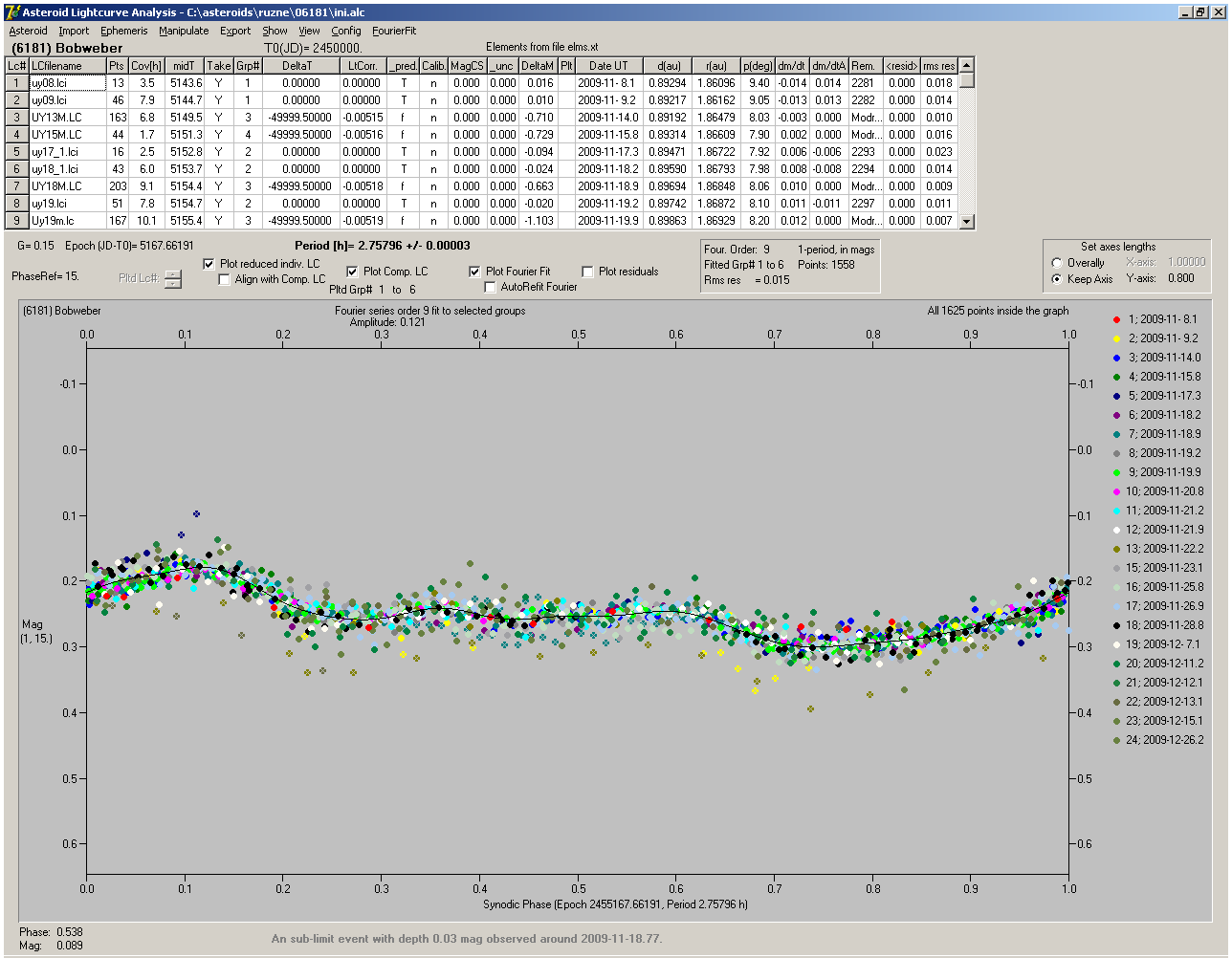
A rotational lightcurve of Bobweber was obtained from photometric observations by Czech astronomer Petr Pravec at Ondřejov Observatory in December 2009. It gave a well-defined rotation period of 2.75796±0.00003 hours with a brightness variation of 0.12 in magnitude (U=3).[a] In January 2014, astronomer Julian Oey at the Australian Blue Mountains Observatory (Q68) obtained a nearly identical period of 2.7576±0.0001 hours with an amplitude of 0.15 magnitude (U=3-).[6]
Diameter and albedo
According to the surveys carried out by NASA's Wide-field Infrared Survey Explorer with its subsequent NEOWISE mission, Bobweber measures 4.5 kilometers in diameter and its surface has a high albedo of 0.42 and 0.43, respectively,[4][5] while the Collaborative Asteroid Lightcurve Link assumes a standard albedo for stony asteroids of 0.20 and calculates a diameter of 5.7 kilometers.[3]
123Masiero, Joseph R.; Mainzer, A. K.; Grav, T.; Bauer, J. M.; Cutri, R. M.; Dailey, J.; etal. (November 2011). "Main Belt Asteroids with WISE/NEOWISE. I. Preliminary Albedos and Diameters". The Astrophysical Journal. 741 (2): 20. arXiv:1109.4096. Bibcode:2011ApJ...741...68M. doi:10.1088/0004-637X/741/2/68.
12Oey, Julian (January 2016). "Lightcurve Analysis of Asteroids from Blue Mountains Observatory in 2014". The Minor Planet Bulletin. 43 (1): 45–51. Bibcode:2016MPBu...43...45O. ISSN1052-8091.