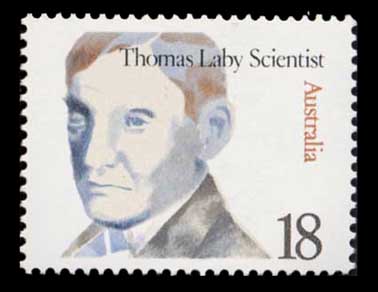
After some schooling at country schools and private study, Laby joined the Taxation Department in 1898 but soon gained a position in the chemical laboratory of the NSW Department of Agriculture.[citation needed]
Career
Laby obtained a position of acting demonstrator in chemistry at the University of Sydney, based on a recommendation by his boss F.B. Guthrie at the Department of Agriculture laboratory.[1] Laby took evening classes at the university and in 1903 had a paper published by the Royal Society of New South Wales, "The separation of iron from nickel and cobalt".[citation needed]
Laby worked with Douglas Mawson, who was then a junior demonstrator in chemistry, later a geologist. The two men were the first to identify radium-bearing ore in Australia,[2] in samples of monazite collected from the Pilbara in Western Australia. They also examined other samples collected from across New South Wales, including the Barrier Ranges, not far from Olary, South Australia, where uranium was identified a couple of years later.[3][2] Mawson built an electroscope based on the design of C. T. R. Wilson in Sydney University engineering laboratory to test samples from their field trips. Professor Edgeworth David made the formal presentation of their paper describing their findings to the Royal Society of New South Wales on 5 October 1904 on the men's behalf.[1][4][5][6]
Laby was appointed to the new chair of physics at Victoria University College in Wellington, New Zealand in 1909 and completed work with George Kaye resulting in publication of Tables of physical and chemical constants with some mathematical functions (London, 1911); the title has had sixteen editions as of 2007.[7][8]
Laby had married in 1914 and the next year was appointed to the chair of natural philosophy at the University of Melbourne. He developed valves for an anti-gas respirator, performed radiographic testing of fuses and inspected X-ray equipment for military hospitals.[citation needed]
In May 1928, he and his team of collaborators from the University of Melbourne conducted street noise measurements from trams in Melbourne, with electronic instruments they manufactured, being the first time in the world that the sound level was recorded with no signal filtering (they did not use an audiometer).[10][11] The first of several street measurements was made on 9 May 1928, at the corner of St Paul's Cathedral where their apparatus was set up at the top of the cathedral steps, and 3LO radio station transmitted the noise captured by the microphone.[12][13]
J. C. Beaglehole, Victoria University College (Wellington, 1949); D. P. Mellor, The Role of Science and Industry (Canberra, 1958); G. Currie and J. Graham, The Origins of CSIRO (Melbourne, 1966); W. F. Evans, History of the Radio Research Board, 1926-1945 (Melb., 1973); J. F. Richardson, The Australian Radiation Laboratory (Canb., 1981); Australian Cancer Conference, Report, 1930–37; Australian Physicist, 17 (Dec 1980); Historical Studies, 20 (Apr 1983); Records of the Australian Academy of Science, 3 (Mar 1975), no. 1