In physics, an electronvolt (symbol eV), also written as electron-volt and electron volt, is a unit of measurement equivalent to the amount of kinetic energy gained by a single electron accelerating through an electric potential difference of one volt in a vacuum. When used as a unit of energy, the numerical value of 1 eV expressed in unit of joules (symbol J) is equal to the numerical value of the charge of an electron in coulombs (symbol C). Under the 2019 revision of the SI, this sets 1eV equal to the exact value 1.602176634×10⁻¹⁹J.[1]
Historically, the electronvolt was devised as a standard unit of measure through its usefulness in electrostatic particle accelerator sciences, because a particle with electric chargeq gains an energy E = qV after passing through a voltage of V.
Definition and use
An electronvolt is the amount of energy gained or lost by a single electron when it moves through an electric potential difference of one volt. Hence, it has a value of one volt, which is 1J/C, multiplied by the elementary chargee=1.602176634×10⁻¹⁹C.[2] Therefore, one electronvolt is equal to 1.602176634×10⁻¹⁹J.[1]
The electronvolt (eV) is a unit of energy, but is not an SI unit. It is a commonly used unit of energy within physics, widely used in solid state, atomic, nuclear and particle physics, and high-energy astrophysics. It is commonly used with SI prefixesmilli- (10−3), kilo- (103), mega- (106), giga- (109), tera- (1012), peta- (1015), exa- (1018), zetta- (1021), yotta- (1024), ronna- (1027), or quetta- (1030), the respective symbols being meV, keV, MeV, GeV, TeV, PeV, EeV, ZeV, YeV, ReV, and QeV. The SI unit of energy is the joule (J).
In some older documents, and in the name Bevatron, the symbol BeV is used, where the B stands for billion. The symbol BeV is therefore equivalent to GeV, though neither is an SI unit.
In the fields of physics in which the electronvolt is used, other quantities are typically measured using units derived from it; products with fundamental constants of importance in the theory are often used.
Mass
By mass–energy equivalence, the electronvolt corresponds to a unit of mass. It is common in particle physics, where units of mass and energy are often interchanged, to express mass in units of eV/c2, where c is the speed of light in vacuum (from E = mc2). It is common to informally express mass in terms of eV as a unit of mass, effectively using a system of natural units with c set to 1.[3] The kilogram equivalent of 1eV/c2 is:
For example, an electron and a positron, each with a mass of 0.511MeV/c2, can annihilate to yield 1.022MeV of energy. A proton has a mass of 0.938GeV/c2. In general, the masses of all hadrons are of the order of 1GeV/c2, which makes the GeV/c2 a convenient unit of mass for particle physics:[4]
1GeV/c2 = 1.78266192×10⁻²⁷kg.
The atomic mass constant (mu), one twelfth of the mass a carbon-12 atom, is close to the mass of a proton. To convert to electronvolt mass-equivalent, use the formula:
mu = 1 Da = 931.4941MeV/c2 = 0.9314941GeV/c2.
Momentum
By dividing a particle's kinetic energy in electronvolts by the fundamental constant c (the speed of light), one can describe the particle's momentum in units of eV/c.[5] In natural units in which the fundamental velocity constant c is numerically 1, the c may informally be omitted to express momentum using the unit electronvolt.
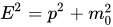
The energy–momentum relation
in natural units (with )
is a Pythagorean equation. When a relatively high energy is applied to a particle with relatively low rest mass, it can be approximated as in high-energy physics such that an applied energy with expressed in the unit eV conveniently results in a numerically approximately equivalent change of momentum when expressed with the uniteV/c.
The dimension of momentum is T−1LM. The dimension of energy is T−2L2M. Dividing a unit of energy (such as eV) by a fundamental constant (such as the speed of light) that has the dimension of velocity (T−1L) facilitates the required conversion for using a unit of energy to quantify momentum.
For example, if the momentum p of an electron is 1GeV/c, then the conversion to MKS system of units can be achieved by:
Distance
In particle physics, a system of natural units in which the speed of light in vacuum c and the reduced Planck constantħ are dimensionless and equal to unity is widely used: c = ħ = 1. In these units, both distances and times are expressed in inverse energy units (while energy and mass are expressed in the same units, see mass–energy equivalence). In particular, particle scattering lengths are often presented using a unit of inverse particle mass.
Outside this system of units, the conversion factors between electronvolt, second, and nanometer are the following:
The above relations also allow expressing the mean lifetimeτ of an unstable particle (in seconds) in terms of its decay width Γ (in eV) via Γ = ħ/τ. For example, the B0 meson has a lifetime of 1.530(9)picoseconds, mean decay length is cτ = 459.7μm, or a decay width of 4.302(25)×10−4eV.
Conversely, the tiny meson mass differences responsible for meson oscillations are often expressed in the more convenient inverse picoseconds.
Energy in electronvolts is sometimes expressed through the wavelength of light with photons of the same energy:
The kB is assumed when using the electronvolt to express temperature, for example, a typical magnetic confinement fusion plasma is 15keV (kiloelectronvolt), which corresponds to 174MK (megakelvin).
As an approximation: at a temperature of T = 20°C, kBT is about 0.025eV (≈ 290 K/11604 K/eV).
Wavelength
Energy of photons in the visible spectrum in eVGraph of wavelength (nm) to energy (eV)
The energy E, frequency ν, and wavelength λ of a photon are related by
where h is the Planck constant, c is the speed of light. This reduces to[6]
A photon with a wavelength of 532nm (green light) would have an energy of approximately 2.33eV. Similarly, 1eV would correspond to an infrared photon of wavelength 1240nm or frequency 241.8THz.
Scattering experiments
In a low-energy nuclear scattering experiment, it is conventional to refer to the nuclear recoil energy in units of eVr, keVr, etc. This distinguishes the nuclear recoil energy from the "electron equivalent" recoil energy (eVee, keVee, etc.) measured by scintillation light. For example, the yield of a phototube is measured in phe/keVee (photoelectrons per keV electron-equivalent energy). The relationship between eV, eVr, and eVee depends on the medium the scattering takes place in, and must be established empirically for each material.
Energy comparisons
Photon frequency vs. energy particle in electronvolts. The energy of a photon varies only with the frequency of the photon, related by the speed of light. This contrasts with a massive particle of which the energy depends on its velocity and rest mass.[7][8][9]
the highest-energy neutrino detected by the KM3NeT neutrino telescope[10]
14TeV
designed proton center-of-mass collision energy at the Large Hadron Collider (operated at 3.5 TeV since its start on 30 March 2010, reached 13 TeV in May 2015)
One mole of particles given 1eV of energy each has approximately 96.5kJ of energy – this corresponds to the Faraday constant (F≈96485C⋅mol−1), where the energy in joules of n moles of particles each with energy EeV is equal to E·F·n.
↑"Units in particle physics". Associate Teacher Institute Toolkit. Fermilab. 22 March 2002. Archived from the original on 14 May 2011. Retrieved 13 February 2011.







![{\displaystyle {\begin{aligned}p=1\;{\text{GeV}}/c&={\frac {10^{9}\times (1.602\ 176\ 634\times 10^{-19}\;{\text{C}})\times (1\;{\text{V}})}{2.99\ 792\ 458\times 10^{8}\;{\text{m}}/{\text{s}}}}\\[1ex]&=5.344\ 286\times 10^{-19}\;{\text{kg}}{\cdot }{\text{m}}/{\text{s}}.\end{aligned}}}](https://wikimedia.org/api/rest_v1/media/math/render/svg/53080c3d2d3b593cd009c7bd9c6cd25e4932af80)





![{\displaystyle {\begin{aligned}E&=4.135\ 667\ 696\times 10^{-15}\;\mathrm {eV/Hz} \times \nu \\[4pt]&={\frac {1\ 239.841\ 98\;\mathrm {eV{\cdot }nm} }{\lambda }}.\end{aligned}}}](https://wikimedia.org/api/rest_v1/media/math/render/svg/00656cf6edf1e4f4d8a4169e26b71a5ffc3d8e74)


