| Symbol |
Unicode
value
(hexadecimal) |
HTML
codes |
LaTeX
symbol |
Logic Name |
Read as |
Category |
Explanation |
Examples |
|---|
⇒
→
⊃ |
U+21D2
U+2192
U+2283 |
⇒
→
⊃
⇒
→
⊃ |
 \Rightarrow  \implies
 \to or \rightarrow  \supset |
material conditional (material implication) |
implies,
if P then Q,
it is not the case that P and not Q |
propositional logic, Boolean algebra, Heyting algebra |
 is false when A is true and B is false but true otherwise. is false when A is true and B is false but true otherwise.
In other mathematical contexts, see glossary of mathematical symbols,  may indicate the domain and codomain of a function and may mean superset. may indicate the domain and codomain of a function and may mean superset. |
 is true, but  is in general false (since x could be −2). |
⇔
↔
≡ |
U+21D4
U+2194
U+2261 |
⇔
↔
≡
⇔
↔
≡ |
 \Leftrightarrow \Leftrightarrow
 \iff \iff
 \leftrightarrow \leftrightarrow
 \equiv \equiv |
material biconditional (material equivalence) |
if and only if, iff, xnor |
propositional logic, Boolean algebra |
 is true only if both A and B are false, or both A and B are true. Whether a symbol means a material biconditional or a logical equivalence, depends on the author’s style. is true only if both A and B are false, or both A and B are true. Whether a symbol means a material biconditional or a logical equivalence, depends on the author’s style. |
 |
|
U+00AC
U+007E
U+0021
U+2032 |
¬
˜
!
′
¬
˜
!
′ |
 \lnot or \neg \lnot or \neg
 \sim \sim
 ' ' |
negation |
not |
propositional logic, Boolean algebra |
The statement  is true if and only if A is false. is true if and only if A is false.
A slash placed through another operator is the same as placed in front.
The prime symbol is placed after the negated thing, e.g.  [2] [2] |
  |
∧
·
& |
U+2227
U+00B7
U+0026 |
∧
·
&
∧
·
&
|
 \wedge or \land  \cdot
 \& [3] |
logical conjunction |
and |
propositional logic, Boolean algebra |
The statement A ∧ B is true if A and B are both true; otherwise, it is false. |
|
∨
+
∥ |
U+2228
U+002B
U+2225 |
∨
+
∥
∨
+
∥ |
 \lor or \vee \lor or \vee
 \parallel \parallel |
logical (inclusive) disjunction |
or |
propositional logic, Boolean algebra |
The statement A ∨ B is true if A or B (or both) are true; if both are false, the statement is false. |
|
⊕
⊻
↮
≢ |
U+2295
U+22BB
U+21AE
U+2262 |
⊕
⊻
↮
≢
⊕
⊻
—
≢ |
 \oplus \oplus
 \veebar \veebar
 \nleftrightarrow \nleftrightarrow
 \not\equiv \not\equiv |
exclusive disjunction |
xor,
either ... or ... (but not both) |
propositional logic, Boolean algebra |
The statement  is true when either A or B, but not both, are true. This is equivalent to is true when either A or B, but not both, are true. This is equivalent to
¬(A ↔ B), hence the symbols  and . and . |
 is always true and  is always false (if vacuous truth is excluded). |
⊤
T
1 |
U+22A4
|
⊤
⊤
|
 \top \top
|
true (tautology) |
top, truth, tautology, verum, full clause |
propositional logic, Boolean algebra, first-order logic |
denotes a proposition that is always true. |
The proposition  is always true since at least one of the two is unconditionally true. |
⊥
F
0 |
U+22A5
|
⊥
⊥
|
 \bot \bot
|
false (contradiction) |
bottom, falsity, contradiction, falsum, empty clause |
propositional logic, Boolean algebra, first-order logic |
denotes a proposition that is always false.
The symbol ⊥ may also refer to perpendicular lines. |
The proposition  is always false since at least one of the two is unconditionally false. |
∀
() |
U+2200
|
∀
∀
|
 \forall \forall
|
universal quantification |
given any, for all, for every, for each, for any |
first-order logic |
  or or
 says “given any says “given any  , has property , has property  .” .” |
 |
∃ |
U+2203 |
∃
∃ |
 \exists \exists |
existential quantification |
there exists, for some |
first-order logic |
 says “there exists an (at least one) such that has property .” says “there exists an (at least one) such that has property .” |
 n n is even. |
∃! |
U+2203 U+0021 |
∃ !
∃! |
 \exists ! \exists ! |
uniqueness quantification |
there exists exactly one |
first-order logic (abbreviation) |
 says “there exists exactly one such that has property .” Only and are part of formal logic. says “there exists exactly one such that has property .” Only and are part of formal logic.
is an abbreviation for  |
 |
( ) |
U+0028 U+0029 |
( )
(
) |
 ( ) ( ) |
precedence grouping |
parentheses; brackets |
almost all logic syntaxes, as well as metalanguage |
Perform the operations inside the parentheses first. |
(8 ÷ 4) ÷ 2 = 2 ÷ 2 = 1, but 8 ÷ (4 ÷ 2) = 8 ÷ 2 = 4. |
 |
U+1D53B |
𝔻
𝔻 |
\mathbb{D} |
domain of discourse |
domain of discourse |
metalanguage (first-order logic semantics) |
|
 |
⊢ |
U+22A2 |
⊢
⊢ |
 \vdash \vdash |
syntactic consequence |
proves, syntactically entails
(single) turnstile |
metalanguage (metalogic) |
 says “ says “ is is
a theorem of  ”. ”.
In other words,
proves via a deductive system. |
 (eg. by using natural deduction) |
⊨ |
U+22A8 |
⊨
⊨ |
 \vDash, \models \vDash, \models |
semantic consequence
or satisfaction |
(semantically) entails
or satisfies, models
double turnstile |
metalanguage (metalogic) |
 says says
“in every model,
it is not the case that is true and is false”.
 says says
a formula
is true in a model  with with
variable assignment  . . |
 (eg. by using truth tables) |
≡
⟚
⇔ |
U+2261
U+27DA
U+21D4 |
≡
—
⇔
≡
—
⇔ |
\equiv
\Leftrightarrow |
logical equivalence |
is logically equivalent to |
metalanguage (metalogic) |
It’s when and  . Whether a symbol means a material biconditional or a logical equivalence, depends on the author’s style. . Whether a symbol means a material biconditional or a logical equivalence, depends on the author’s style. |
 |
⊬ |
U+22AC |
|
⊬\nvdash |
|
does not syntactically entail (does not prove) |
metalanguage (metalogic) |
 says “ is says “ is
not a theorem of ”.
In other words,
is not derivable from via a deductive system. |
 |
⊭ |
U+22AD |
|
⊭\nvDash |
|
does not semantically entail |
metalanguage (metalogic) |
 says “ does not guarantee the truth of ”. says “ does not guarantee the truth of ”.
In other words,
does not make true. |
 |
□ |
U+25A1 |
|
 \Box \Box |
necessity (in a model) |
box; it is necessary that |
modal logic |
modal operator for "it is necessary that"
in alethic logic, "it is provable that"
in provability logic, "it is obligatory that"
in deontic logic, "it is believed that"
in doxastic logic,
"it is known that"
in autoepistemic logic. |
 says “it is necessary that everything has property ” |
◇ |
U+25C7 |
|
 \Diamond \Diamond |
possibility (in a model) |
diamond;
it is possible that |
modal logic |
modal operator for “it is possible that”, (in most modal logics it is defined as “¬□¬”, “it is not necessarily not”). |
 says “it is possible that something has property ” |
∴ |
U+2234 |
|
∴\therefore |
therefore |
therefore |
metalanguage |
abbreviation for “therefore”. |
|
∵ |
U+2235 |
|
∵\because |
because |
because |
metalanguage |
abbreviation for “because”. |
|
≔
≜
≝ |
U+2254
U+225C
U+225D |
≔
≔
|
≔ \coloneqq  :=  \triangleq

\stackrel{
\scriptscriptstyle \mathrm{def}}{=}
|
definition |
is defined as |
metalanguage |
 means "from now on, means "from now on,  is defined to be another name for is defined to be another name for  ." This is a statement in the metalanguage, not the object language. The notation ." This is a statement in the metalanguage, not the object language. The notation  may occasionally be seen in physics, meaning the same as . may occasionally be seen in physics, meaning the same as . |
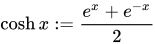 |
|
U+2191
U+007C
U+22BC |
|
 \uparrow \uparrow
 \vert, \mid \vert, \mid
 \barwedge \barwedge
|
Sheffer stroke, NAND |
NAND, not both
up arrow |
Propositional logic |
NAND is the negation of conjunction so  is true if and only if it's not the case that both A and B are true. is true if and only if it's not the case that both A and B are true.
See also NAND gate |
|
|
U+2193
U+22BD |
|
 \downarrow \downarrow
 \overline{\vee} \overline{\vee}
|
Peirce Arrow,
NOR |
nor
down arrow |
Propositional logic |
NOR is the negation of disjunction so  is true if and only if both A and B are false. is true if and only if both A and B are false.
See also NOR gate |
|


