In the situation where data is available for k different treatment groups having size ni where i varies from 1 to k, then it is assumed that the expected mean of each group is
and the variance of each treatment group is unchanged from the population variance .
Under the Null Hypothesis that the treatments have no effect, then each of the will be zero.
It is now possible to calculate three sums of squares:
Individual
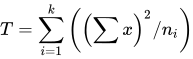
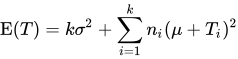
Treatments
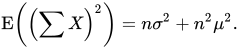
Under the null hypothesis that the treatments cause no differences and all the are zero, the expectation simplifies to
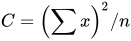
Combination
Sums of squared deviations
Under the null hypothesis, the difference of any pair of I, T, and C does not contain any dependency on , only .
The constants (n−1), (k−1), and (n−k) are normally referred to as the number of degrees of freedom.
Example
In a very simple example, 5 observations arise from two treatments. The first treatment gives three values 1, 2, and 3, and the second treatment gives two values 4, and 6.
Giving
Total squared deviations = 66 − 51.2 = 14.8 with 4 degrees of freedom.
Treatment squared deviations = 62 − 51.2 = 10.8 with 1 degree of freedom.
Residual squared deviations = 66 − 62 = 4 with 3 degrees of freedom.
Researchers use this test to see if two factors act independent or combined to influence a Dependent variable. It is used in the fields of Psychology, Agriculture, Education, and Biomedical research.[3] For example, it can be used to study how fertilizer type and water level together affect plant growth. The analysis produces F-statistics that indicate whether observed differences between groups are statistically significant.[4][3]