A flow chart describing the relationship of various physical quantities, including radiant flux and exitance
In radiometry, radiant flux or radiant power is the radiant energy emitted, reflected, transmitted, or received per unit time, and spectral flux or spectral power is the radiant flux per unit frequency or wavelength, depending on whether the spectrum is taken as a function of frequency or of wavelength. The SI unit of radiant flux is the watt (W), one joule per second (J/s), while that of spectral flux in frequency is the watt per hertz (W/Hz) and that of spectral flux in wavelength is the watt per metre (W/m)—commonly the watt per nanometre (W/nm). Radiant flux is sometimes called luminosity, especially in astronomy contexts.
Mathematical definitions
Radiant flux
Radiant flux, denoted Φe ('e' for "energetic", to avoid confusion with photometric quantities), is defined as[1]
where
S is the Poynting vector, representing the directional flow of energy per unit time, per unit area;
n is the unit normal vector to the differential area element dA.
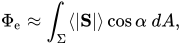
The rate of energy flow through the surface fluctuates at the frequency of the radiation, but radiation detectors only respond to the average rate of flow. This is represented by replacing the Poynting vector with the time average of its norm, giving
where ⟨-⟩ is the time average, and α is the angle between n and S.
Spectral flux
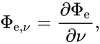
Spectral flux in frequency, denoted Φe,ν, is defined as[1]
where ν is the frequency.
Spectral flux in wavelength, denoted Φe,λ, is defined as[1]
where λ is the wavelength.
SI radiometry units
Comparison of photometric and radiometric quantities
Radiant energy emitted, reflected, transmitted or received, per unit time. This is sometimes also called "radiant power", and called luminosity in astronomy.
Radiant flux emitted, reflected, transmitted or received by a surface, per unit solid angle per unit projected area. This is a directional quantity. This is sometimes also called "intensity".
Radiance of a surface per unit frequency or wavelength. The latter is commonly measured in W⋅sr−1⋅m−2⋅nm−1. This is a directional quantity. This is sometimes also called "spectral intensity".
Irradiance of a surface per unit frequency or wavelength. This is sometimes also called "spectral intensity". Non-SI units of spectral flux density include jansky (1Jy = 10−26W⋅m−2⋅Hz−1) and solar flux unit (1sfu = 10−22W⋅m−2⋅Hz−1 = 104Jy).
Radiosity of a surface per unit frequency or wavelength. The latter is commonly measured in W⋅m−2⋅nm−1. This is sometimes also called "spectral intensity".
Radiant flux emitted by a surface per unit area. This is the emitted component of radiosity. "Radiant emittance" is an old term for this quantity. This is sometimes also called "intensity".
Radiant exitance of a surface per unit frequency or wavelength. The latter is commonly measured in W⋅m−2⋅nm−1. "Spectral emittance" is an old term for this quantity. This is sometimes also called "spectral intensity".
Radiant energy received by a surface per unit area, or equivalently irradiance of a surface integrated over time of irradiation. This is sometimes also called "radiant fluence".
Radiant exposure of a surface per unit frequency or wavelength. The latter is commonly measured in J⋅m−2⋅nm−1. This is sometimes also called "spectral fluence".
↑Standards organizations recommend that radiometric quantities should be denoted with suffix "e" (for "energetic") to avoid confusion with photometric or photon quantities.
12345Alternative symbols sometimes seen: W or E for radiant energy, P or F for radiant flux, I for irradiance, W for radiant exitance.
1234567Spectral quantities given per unit frequency are denoted with suffix "ν" (Greek letter nu, not to be confused with a letter "v", indicating a photometric quantity.)
1234567Spectral quantities given per unit wavelength are denoted with suffix "λ".
12Directional quantities are denoted with suffix "Ω".


![{\displaystyle {\begin{aligned}\Phi _{\mathrm {e} }&={\frac {dQ_{\mathrm {e} }}{dt}}\\[2pt]Q_{\mathrm {e} }&=\int _{T}\int _{\Sigma }\mathbf {S} \cdot {\hat {\mathbf {n} }}\,dAdt\end{aligned}}}](https://wikimedia.org/api/rest_v1/media/math/render/svg/eebeae5e669aa3dd16351cb0a3a3d522a88210e8)