In radiometry, irradiance is the radiant fluxreceived by a surface per unit area. The SI unit of irradiance is the watt per square metre (symbol W⋅m−2 or W/m2). The CGS uniterg per square centimetre per second (erg⋅cm−2⋅s−1) is often used in astronomy. Irradiance is often called intensity, but this term is avoided in radiometry where such usage leads to confusion with radiant intensity. In astrophysics, irradiance is called radiant flux.[1]
Spectral irradiance is the irradiance of a surface per unit frequency or wavelength, depending on whether the spectrum is taken as a function of frequency or of wavelength. The two forms have different dimensions and units: spectral irradiance of a frequency spectrum is measured in watts per square metre per hertz (W⋅m−2⋅Hz−1), while spectral irradiance of a wavelength spectrum is measured in watts per square metre per metre (W⋅m−3), or more commonly watts per square metre per nanometre (W⋅m−2⋅nm−1).
Mathematical definitions
Comparison of photometric and radiometric quantities
Irradiance
Irradiance of a surface, denoted Ee ("e" for "energetic", to avoid confusion with photometric quantities), is defined as[2]
The radiant flux emitted by a surface is called radiant exitance.
Spectral irradiance
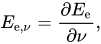
Spectral irradiance in frequency of a surface, denoted Ee,ν, is defined as[2]
where ν is the frequency.
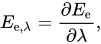
Spectral irradiance in wavelength of a surface, denoted Ee,λ, is defined as[2]
where λ is the wavelength.
Property
Irradiance of a surface is also, according to the definition of radiant flux, equal to the time-average of the component of the Poynting vector perpendicular to the surface:
where
⟨ • ⟩ is the time-average;
S is the Poynting vector;
α is the angle between a unit vector normal to the surface and S.
For a propagating sinusoidallinearly polarized electromagnetic plane wave, the Poynting vector always points to the direction of propagation while oscillating in magnitude. The irradiance of a surface is then given by[3]
For quick approximations, this equation indicates that doubling the distance reduces irradiation to one quarter; or similarly, to double irradiation, reduce the distance to 71%.
In astronomy, stars are routinely treated as point sources even though they are much larger than the Earth. This is a good approximation because the distance from even a nearby star to the Earth is much larger than the star's diameter. For instance, the irradiance of Alpha Centauri A (radiant flux: 1.5 L☉, distance: 4.34 ly) is about 2.7 × 10⁻⁸ W/m2 on Earth.
The global irradiance on a horizontal surface on Earth consists of the direct irradiance Ee,dir and diffuse irradiance Ee,diff. On a tilted plane, there is another irradiance component, Ee,refl, which is the component that is reflected from the ground. The average ground reflection is about 20% of the global irradiance. Hence, the irradiance Ee on a tilted plane consists of three components:[4]
Average solar irradiance at the top of the Earth's atmosphere is roughly 1361 W/m2, but at surface irradiance is approximately 1000 W/m2 on a clear day.
Radiant energy emitted, reflected, transmitted or received, per unit time. This is sometimes also called "radiant power", and called luminosity in astronomy.
Radiant flux emitted, reflected, transmitted or received by a surface, per unit solid angle per unit projected area. This is a directional quantity. This is sometimes also called "intensity".
Radiance of a surface per unit frequency or wavelength. The latter is commonly measured in W⋅sr−1⋅m−2⋅nm−1. This is a directional quantity. This is sometimes also called "spectral intensity".
Irradiance of a surface per unit frequency or wavelength. This is sometimes also called "spectral intensity". Non-SI units of spectral flux density include jansky (1Jy = 10−26W⋅m−2⋅Hz−1) and solar flux unit (1sfu = 10−22W⋅m−2⋅Hz−1 = 104Jy).
Radiosity of a surface per unit frequency or wavelength. The latter is commonly measured in W⋅m−2⋅nm−1. This is sometimes also called "spectral intensity".
Radiant flux emitted by a surface per unit area. This is the emitted component of radiosity. "Radiant emittance" is an old term for this quantity. This is sometimes also called "intensity".
Radiant exitance of a surface per unit frequency or wavelength. The latter is commonly measured in W⋅m−2⋅nm−1. "Spectral emittance" is an old term for this quantity. This is sometimes also called "spectral intensity".
Radiant energy received by a surface per unit area, or equivalently irradiance of a surface integrated over time of irradiation. This is sometimes also called "radiant fluence".
Radiant exposure of a surface per unit frequency or wavelength. The latter is commonly measured in J⋅m−2⋅nm−1. This is sometimes also called "spectral fluence".
↑Standards organizations recommend that radiometric quantities should be denoted with suffix "e" (for "energetic") to avoid confusion with photometric or photon quantities.
12345Alternative symbols sometimes seen: W or E for radiant energy, P or F for radiant flux, I for irradiance, W for radiant exitance.
1234567Spectral quantities given per unit frequency are denoted with suffix "ν" (Greek letter nu, not to be confused with a letter "v", indicating a photometric quantity.)
1234567Spectral quantities given per unit wavelength are denoted with suffix "λ".
12Directional quantities are denoted with suffix "Ω".
Comparison of photometric and radiometric quantities