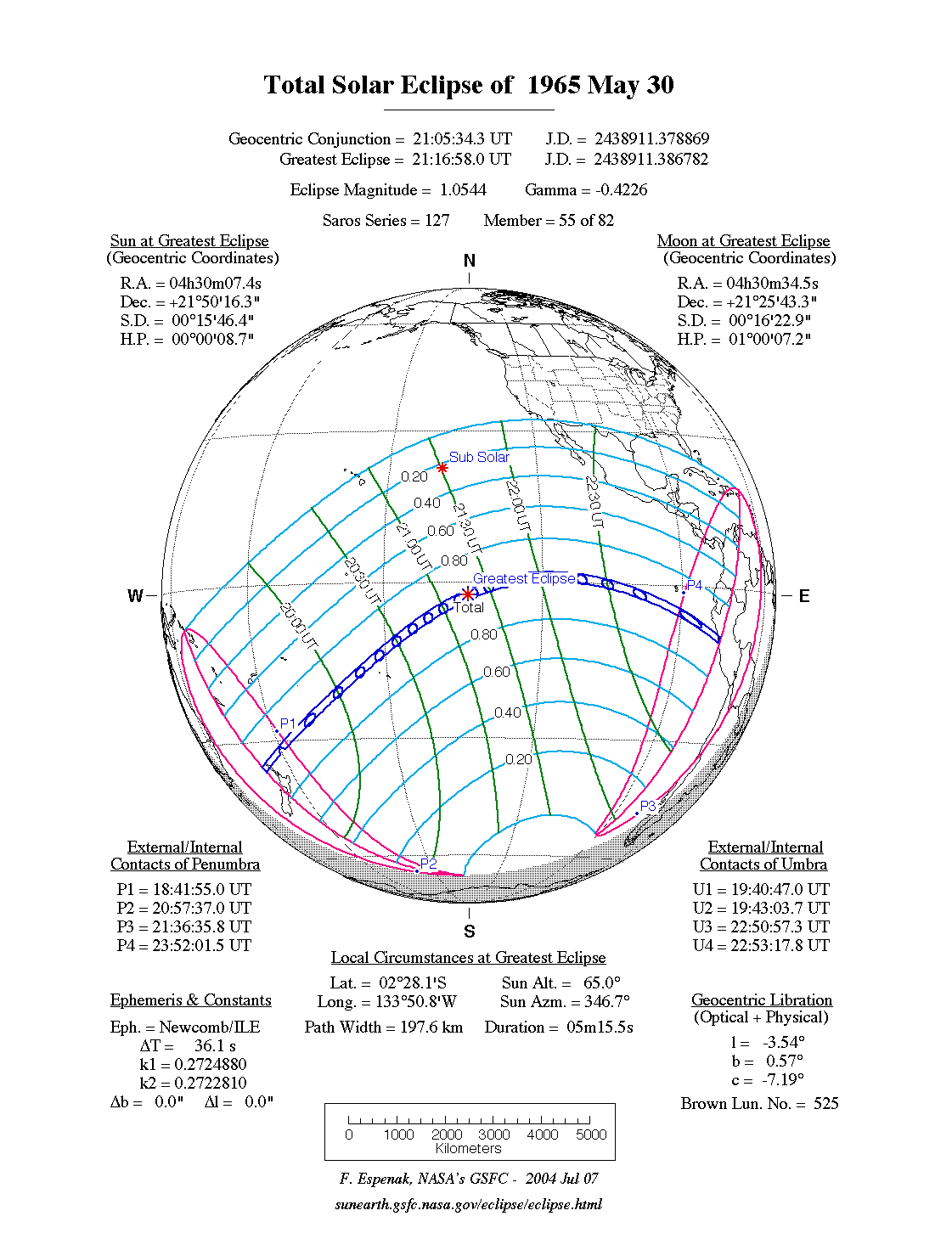
A total solar eclipse occurred at the Moon's ascending node of orbit between Sunday, May 30 and Monday, May 31, 1965,[1] with a magnitude of 1.0544. A solar eclipse occurs when the Moon passes between Earth and the Sun, thereby totally or partly obscuring the image of the Sun for a viewer on Earth. A total solar eclipse occurs when the Moon's apparent diameter is larger than the Sun's, blocking all direct sunlight, turning day into darkness. Totality occurs in a narrow path across Earth's surface, with the partial solar eclipse visible over a surrounding region thousands of kilometres wide. Occurring about 1.9 days before perigee (on June 1, 1965, at 19:20 UTC), the Moon's apparent diameter was larger.[2]
As most of the eclipse's path was over open ocean, a prolonged observation was made by a jet transport; flying parallel to the path of the eclipse at 587mph (945km/h), this gave scientists what was at the time the "longest probe in man's history into the conditions of a solar eclipse", for nearly ten minutes. The expedition involved scientists from NASA, Belgium, Italy, the Netherlands, and Switzerland; in total, 30 researchers and 13 separate research projects were represented on the plane.[3][4][5] The plane, operated by NASA, took off from Hilo, Hawaii, and met up with the path of the eclipse approximately 1,000mi (1,600km) south of there.[6] While mostly invisible from land, some ground-based observers in an 85-mile-wide strip of northern New Zealand were able to clearly view the event.[6]
New Zealand, Australia, the United Kingdom, the United States, Germany, Japan and the Soviet Union sent observation teams to Manuae, Cook Islands to observe the total eclipse. The New Zealand government deployed ships to transport passengers from Rarotonga, the island where the national capital Avarua is located, to Manuae. The atoll has a total area of 1,524 hectares, and only a few copra workers lived there permanently. During the totality, there were 85 scientists as well as their assistants on the atoll. The Sun was obscured by clouds during the eclipse and observations were not successful.[7] In the northern part of New Zealand's North Island, the total eclipse occurred shortly after sunrise on May 31 local time. Although there were some clouds in the sky on the previous evening, the eclipse was seen successfully. In addition, scientists also launched rockets to obtain observation data from high altitude.[8]
Eclipse details
Shown below are two tables displaying details about this particular solar eclipse. The first table outlines times at which the Moon's penumbra or umbra attains the specific parameter, and the second table describes various other parameters pertaining to this eclipse.[9]
This eclipse is part of an eclipse season, a period, roughly every six months, when eclipses occur. Only two (or occasionally three) eclipse seasons occur each year, and each season lasts about 35 days and repeats just short of six months (173 days) later; thus two full eclipse seasons always occur each year. Either two or three eclipses happen each eclipse season. In the sequence below, each eclipse is separated by a fortnight.
This eclipse is a member of a semester series. An eclipse in a semester series of solar eclipses repeats approximately every 177 days and 4 hours (a semester) at alternating nodes of the Moon's orbit.[10]
This eclipse is a part of Saros series 127, repeating every 18 years, 11 days, and containing 82 events. The series started with a partial solar eclipse on October 10, 991 AD. It contains total eclipses from May 14, 1352 through August 15, 2091. There are no annular or hybrid eclipses in this set. The series ends at member 82 as a partial eclipse on March 21, 2452. Its eclipses are tabulated in three columns; every third eclipse in the same column is one exeligmos apart, so they all cast shadows over approximately the same parts of the Earth.
The longest duration of totality was produced by member 31 at 5 minutes, 40 seconds on August 30, 1532. All eclipses in this series occur at the Moon’s ascending node of orbit.[11]
The metonic series repeats eclipses every 19 years (6939.69 days), lasting about 5 cycles. Eclipses occur in nearly the same calendar date. In addition, the octon subseries repeats 1/5 of that or every 3.8 years (1387.94 days). All eclipses in this table occur at the Moon's ascending node.
22 eclipse events between January 5, 1935 and August 11, 2018
This eclipse is a part of a tritos cycle, repeating at alternating nodes every 135 synodic months (≈ 3986.63 days, or 11 years minus 1 month). Their appearance and longitude are irregular due to a lack of synchronization with the anomalistic month (period of perigee), but groupings of 3 tritos cycles (≈ 33 years minus 3 months) come close (≈ 434.044 anomalistic months), so eclipses are similar in these groupings.
This eclipse is a part of the long period inex cycle, repeating at alternating nodes, every 358 synodic months (≈ 10,571.95 days, or 29 years minus 20 days). Their appearance and longitude are irregular due to a lack of synchronization with the anomalistic month (period of perigee). However, groupings of 3 inex cycles (≈ 87 years minus 2 months) comes close (≈ 1,151.02 anomalistic months), so eclipses are similar in these groupings.


.jpg)