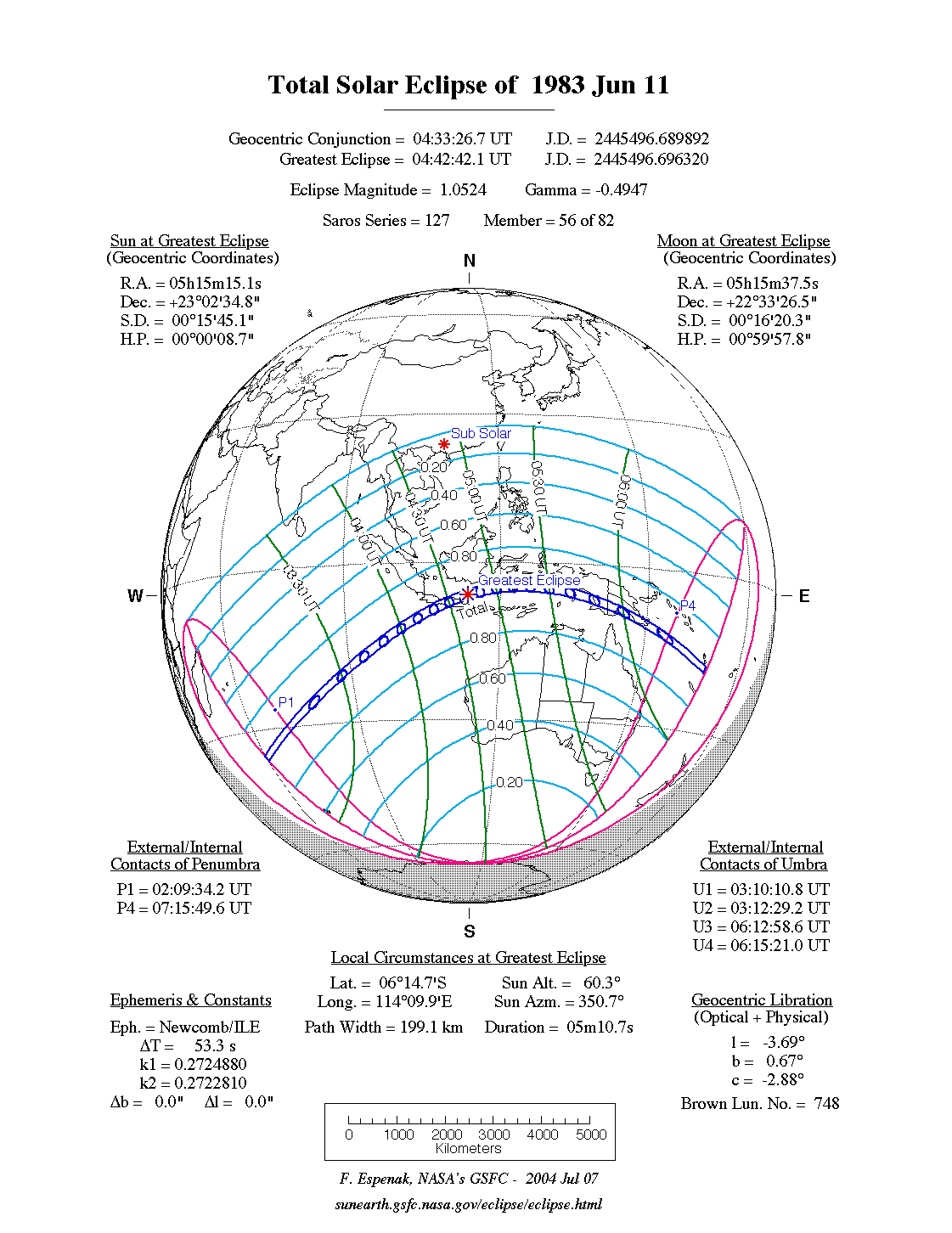
A total solar eclipse occurred at the Moon's ascending node of orbit on Saturday, June 11, 1983,[1] with a magnitude of 1.0524. A solar eclipse occurs when the Moon passes between Earth and the Sun, thereby totally or partly obscuring the image of the Sun for a viewer on Earth. A total solar eclipse occurs when the Moon's apparent diameter is larger than the Sun's, blocking all direct sunlight, turning day into darkness. Totality occurs in a narrow path across Earth's surface, with the partial solar eclipse visible over a surrounding region thousands of kilometres wide. Occurring about 2.1 days before perigee (on June 13, 1983, at 6:50 UTC), the Moon's apparent diameter was larger.[2]
To avoid blindness, Indonesian dictator president Suharto prohibited local people from observing the eclipse directly through then Information Minister Harmoko, only allowing foreigners to observe from faraway places. Besides the requirements of closing and draping over all windows and airshafts, children were asked to hide themselves in cupboards and below desks as the eclipsing sun's rays were said to be more dangerous to children than to adults. They were allowed to watch a live broadcast of the eclipse occurring over Borobudur Temple in Magelang, Central Java, on state-owned TV channel TVRI. Because of the difference in restriction's intensity between regions, some locals did observe it.[3]
Observation
The Chinese Eclipse Observation Team formed by Beijing Astronomical Observatory (now incorporated into the National Astronomical Observatories of China), Purple Mountain Observatory and Nanjing Astronomical Instrument Factory conducted observation in Port Moresby. Observation in Port Moresby was successful due to the cloudless weather during the eclipse, compared with the cloudy weather in Yogyakarta where teams from many countries went. The Chinese team did spectrum observations of the chromosphere and corona, the broadband corona luminosity and polarization, and the coloured photography of the whole eclipse process.[4]
Eclipse details
Shown below are two tables displaying details about this particular solar eclipse. The first table outlines times at which the Moon's penumbra or umbra attains the specific parameter, and the second table describes various other parameters pertaining to this eclipse.[5]
This eclipse is part of an eclipse season, a period, roughly every six months, when eclipses occur. Only two (or occasionally three) eclipse seasons occur each year, and each season lasts about 35 days and repeats just short of six months (173 days) later; thus two full eclipse seasons always occur each year. Either two or three eclipses happen each eclipse season. In the sequence below, each eclipse is separated by a fortnight.
This eclipse is a member of a semester series. An eclipse in a semester series of solar eclipses repeats approximately every 177 days and 4 hours (a semester) at alternating nodes of the Moon's orbit.[6]
This eclipse is a part of Saros series 127, repeating every 18 years, 11 days, and containing 82 events. The series started with a partial solar eclipse on October 10, 991 AD. It contains total eclipses from May 14, 1352 through August 15, 2091. There are no annular or hybrid eclipses in this set. The series ends at member 82 as a partial eclipse on March 21, 2452. Its eclipses are tabulated in three columns; every third eclipse in the same column is one exeligmos apart, so they all cast shadows over approximately the same parts of the Earth.
The longest duration of totality was produced by member 31 at 5 minutes, 40 seconds on August 30, 1532. All eclipses in this series occur at the Moon’s ascending node of orbit.[7]
The metonic series repeats eclipses every 19 years (6939.69 days), lasting about 5 cycles. Eclipses occur in nearly the same calendar date. In addition, the octon subseries repeats 1/5 of that or every 3.8 years (1387.94 days). All eclipses in this table occur at the Moon's ascending node.
20 eclipse events between June 10, 1964 and August 21, 2036
This eclipse is a part of a tritos cycle, repeating at alternating nodes every 135 synodic months (≈ 3986.63 days, or 11 years minus 1 month). Their appearance and longitude are irregular due to a lack of synchronization with the anomalistic month (period of perigee), but groupings of 3 tritos cycles (≈ 33 years minus 3 months) come close (≈ 434.044 anomalistic months), so eclipses are similar in these groupings.
This eclipse is a part of the long period inex cycle, repeating at alternating nodes, every 358 synodic months (≈ 10,571.95 days, or 29 years minus 20 days). Their appearance and longitude are irregular due to a lack of synchronization with the anomalistic month (period of perigee). However, groupings of 3 inex cycles (≈ 87 years minus 2 months) comes close (≈ 1,151.02 anomalistic months), so eclipses are similar in these groupings.


.jpg)