The standard Compton wavelength λ of a particle of massm is given by
where h is the Planck constant and c is the speed of light.
The corresponding frequency f is given by
and the angular frequency ω is given by
Reduced Compton wavelength
The reduced Compton wavelengthƛ (barred lambda) of a particle is defined as its Compton wavelength divided by 2π:
where ħ is the reduced Planck constant. The reduced Compton wavelength is a natural representation of mass on the quantum scale and is used in equations that pertain to inertial mass, such as the Klein–Gordon and Schrödinger equations.[1]
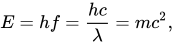
Equations that pertain to the wavelengths of photons interacting with mass use the non-reduced Compton wavelength. A particle of mass m has a rest energy of E = mc2. The Compton wavelength for this particle is the wavelength of a photon of the same energy. For photons of frequencyf, energy is given by
which yields the Compton wavelength formula if solved for λ.
Role in equations for massive particles
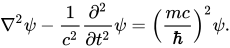
The inverse reduced Compton wavelength is a natural representation for mass on the quantum scale, and as such, it appears in fundamental equations of quantum mechanics. The reduced Compton wavelength appears in the relativistic Klein–Gordon equation for a free particle:
The reduced Compton wavelength is also present in the Schrödinger equation for an electron in a hydrogen-like atom, although this is not readily apparent in traditional representations of the equation. The following is the traditional representation of the Schrödinger equation:
A particle whose Compton wavelength meets its Schwarzschild radius has one Planck mass, spans one Planck length, and radiates one Planck energy.
Typical atomic lengths, wave numbers, and areas in physics can be related to the reduced Compton wavelength for the electron () and the electromagnetic fine-structure constant().
The Bohr radius is related to the Compton wavelength by:
The angular wavenumber of a photon with one hartree (the atomic unit of energy , where is the Rydberg constant), being (approximately) the negative potential energy of the electron in the hydrogen atom, and twice the energy needed to ionize it, is:
This yields the sequence:
For fermions, the classical (electromagnetic) radius sets the cross-section of electromagnetic interactions of a particle. For example, the cross-section for Thomson scattering of a photon from an electron is equal to
which is roughly the same as the cross-sectional area of an iron-56 nucleus.
Geometrical interpretation
A geometrical origin of the Compton wavelength has been demonstrated using semiclassical equations describing the motion of a wavepacket.[8] In this case, the Compton wavelength is equal to the square root of the quantum metric, a metric describing the quantum space: .