Proofs
Here we provide two proofs. The first[2] operates in the general case, using linear maps. The second proof[6] looks at the homogeneous system  where
where  is a
is a  with rank
  and shows explicitly that there exists a set of
  linearly independent solutions that span the null space of .
While the theorem requires that the domain of the linear map be finite-dimensional, there is no such assumption on the codomain. This means that there are linear maps not given by matrices for which the theorem applies. Despite this, the first proof is not actually more general than the second: since the image of the linear map is finite-dimensional, we can represent the map from its domain to its image by a matrix, prove the theorem for that matrix, then compose with the inclusion of the image into the full codomain.
First proof
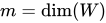
Let  be vector spaces over some field
  and
and  defined as in the statement of the theorem with
  .
.
As  is a subspace, there exists a basis for it. Suppose
  and let
 be such a basis.
We may now, by the Steinitz exchange lemma, extend  with
with  linearly independent vectors
  to form a full basis of
  .
.
Let
 such that
 is a basis for .
From this, we know that
is a basis for .
From this, we know that


We now claim that  is a basis for
  .
The above equality already states that is a generating set for ; it remains to be shown that it is also linearly independent to conclude that it is a basis.
.
The above equality already states that is a generating set for ; it remains to be shown that it is also linearly independent to conclude that it is a basis.
Suppose is not linearly independent, and let
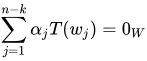 for some
  .
.
Thus, owing to the linearity of , it follows that
 This is a contradiction to
  being a basis, unless all
  are equal to zero. This shows that is linearly independent, and more specifically that it is a basis for .
To summarize, we have , a basis for  , and , a basis for .
Finally we may state that


This concludes our proof.
Second proof
Let be an matrix with  linearly independent columns (i.e.
 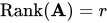 ). We will show that:
- There exists a set of linearly independent solutions to the homogeneous system
 .
. - That every other solution is a linear combination of these solutions.
To do this, we will produce an  matrix
  whose columns form a basis of the null space of .
Without loss of generality, assume that the first columns of are linearly independent. So, we can write
 where
where
 is an
is an  matrix with linearly independent column vectors, and
 is an
is an  matrix such that each of its columns is linear combinations of the columns of .
This means that  for some
  matrix
  (see rank factorization) and, hence,

Let
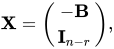 where
where  is the
  identity matrix. So, is an matrix such that

Therefore, each of the columns of are particular solutions of  .
.
Furthermore, the columns of are linearly independent because  will imply
  for
for  :
:
 Therefore, the column vectors of constitute a set of linearly independent solutions for
  .
.
We next prove that any solution of  must be a linear combination of the columns of .
For this, let
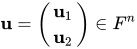
be any vector such that  . Since the columns of are linearly independent,
  implies
  .
.
Therefore,


This proves that any vector  that is a solution of must be a linear combination of the special solutions given by the columns of . And we have already seen that the columns of are linearly independent. Hence, the columns of constitute a basis for the null space of . Therefore, the nullity of is . Since equals rank of , it follows that
  . This concludes our proof.
This theorem is a statement of the first isomorphism theorem of algebra for the case of vector spaces; it generalizes to the splitting lemma.
In more modern language, the theorem can also be phrased as saying that each short exact sequence of vector spaces splits. Explicitly, given that
 is a short exact sequence of vector spaces, then
  , hence
 Here
Here  plays the role of and
  is , i.e.

In the finite-dimensional case, this formulation is susceptible to a generalization: if
 is an exact sequence of finite-dimensional vector spaces, then[9]
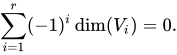 The rank–nullity theorem for finite-dimensional vector spaces may also be formulated in terms of the index of a linear map. The index of a linear map
  , where and
  are finite-dimensional, is defined by

Intuitively,  is the number of independent solutions
  of the equation
  , and
, and  is the number of independent restrictions that have to be put on
  to make
  solvable. The rank–nullity theorem for finite-dimensional vector spaces is equivalent to the statement

We see that we can easily read off the index of the linear map from the involved spaces, without any need to analyze in detail. This effect also occurs in a much deeper result: the Atiyah–Singer index theorem states that the index of certain differential operators can be read off the geometry of the involved spaces.