A plot illustrating the dependence on temperature of the rates of chemical reactions and various biological processes, for several different Q10 temperature coefficients. The rate ratio at a temperature increase of 10 degrees (marked by points) is equal to the Q10 coefficient.
The Q10 temperature coefficient is a mathematical parameter that is thought to come from the late 19th century, in the work of van ’t Hoff.[1]Q10 is a measure of temperature sensitivity based on chemical reaction rates, and it applies to most physiological processes (e.g., respiration, digestion, photosynthesis).[2][3]
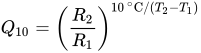
Rewriting this equation, the assumption behind Q10 is that the reaction rate R depends exponentially on temperature:
Q10 is a unitless quantity, as it is the factor by which a rate changes. In this equation, R1 represents the rate at the reference temperature T1. In environmental sciences, the reference temperature for calculating Q10 is often chosen to be 0 °C or 10°C.[4][5][6][7] If the reference temperature is 10 °C, Q10 represents the factor by which the rate is multiplied for each 10°C increase in temperature. For most biological systems, the Q10 value is ~ 2 to 3 (the rate doubles or triples for every 10 °C increase in temperature).[8][3]
In muscle performance
The effects of temperature on enzyme activity. Top - increasing temperature increases the rate of reaction (Q10 coefficient). Middle - the fraction of folded and functional enzyme decreases above its denaturation temperature. Bottom - consequently, an enzyme's optimal rate of reaction is at an intermediate temperature.
The temperature of a muscle has a significant effect on the velocity and power of the muscle contraction, with performance generally declining with decreasing temperatures and increasing with rising temperatures. The Q10 coefficient represents the degree of temperature dependence a muscle exhibits as measured by contraction rates.[9] A Q10 of 1.0 indicates thermal independence of a muscle whereas an increasing Q10 value indicates increasing thermal dependence. Values less than 1.0 indicate a negative or inverse thermal dependence, i.e., a decrease in muscle performance as temperature increases.[10]
Q10 values for biological processes vary with temperature. Decreasing muscle temperature results in a substantial decline of muscle performance such that a 10 degree Celsius temperature decrease results in at least a 50% decline in muscle performance.[11] Persons who have fallen into icy water may gradually lose the ability to swim or grasp safety lines due to this effect, although other effects such as atrial fibrillation are a more immediate cause of drowning deaths. At some minimum temperature biological systems do not function at all, but performance increases with rising temperature (Q10 of 2-4) to a maximum performance level and thermal independence (Q10 of 1.0-1.5). With continued increase in temperature, performance decreases rapidly (Q10 of 0.2-0.8) up to a maximum temperature at which all biological function again ceases.[12]
Within vertebrates, different skeletal muscle activity has correspondingly different thermal dependencies. The rate of muscle twitch contractions and relaxations are thermally dependent (Q10 of 2.0-2.5), whereas maximum contraction, e.g., tetanic contraction, is thermally independent.[13]
Muscles of some ectothermic species. e.g., sharks, show less thermal dependence at lower temperatures than endothermic species [11][14]
12Deban SM, Lappin AK (April 2011). "Thermal effects on the dynamics and motor control of ballistic prey capture in toads: maintaining high performance at low temperature". The Journal of Experimental Biology. 214 (Pt 8): 1333–46. Bibcode:2011JExpB.214.1333D. doi:10.1242/jeb.048405. PMID21430211.
↑Donley JM, Shadwick RE, Sepulveda CA, Syme DA (April 2007). "Thermal dependence of contractile properties of the aerobic locomotor muscle in the leopard shark and shortfin mako shark". The Journal of Experimental Biology. 210 (Pt 7): 1194–203. Bibcode:2007JExpB.210.1194D. doi:10.1242/jeb.02730. PMID17371918.