ENSIKLOPEDIA
PLS (complexity)
In computational complexity theory, Polynomial Local Search (PLS) is a complexity class that models the difficulty of finding a locally optimal solution to an optimization problem. The main characteristics of problems that lie in PLS are that the cost of a solution can be calculated in polynomial time and the neighborhood of a solution can be searched in polynomial time. Therefore it is possible to verify whether or not a solution is a local optimum in polynomial time. Furthermore, depending on the problem and the algorithm that is used for solving the problem, it might be faster to find a local optimum instead of a global optimum.
Description
When searching for a local optimum, there are two interesting issues to deal with: First how to find a local optimum, and second how long it takes to find a local optimum. For many local search algorithms, it is not known, whether they can find a local optimum in polynomial time or not.[1] So to answer the question of how long it takes to find a local optimum, Johnson, Papadimitriou and Yannakakis [2] introduced the complexity class PLS in their paper "How easy is local search?". It contains local search problems for which the local optimality can be verified in polynomial time.
A local search problem is in PLS, if the following properties are satisfied:
- The size of every solution is polynomially bounded in the size of the instance
.
- It is possible to find some solution of a problem instance in polynomial time.
- It is possible to calculate the cost of each solution in polynomial time.
- It is possible to find all neighbors of each solution in polynomial time.
With these properties, it is possible to find for each solution 
Example
Consider the following instance 
A solution 


The cost of each solution is the number of satisfied clauses, so 
The Flip-neighbor of a solution 
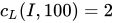
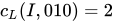
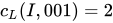
There are no neighbors with better costs than 

Intuitively it can be argued that this problem lies in PLS, because:
- It is possible to find a solution to an instance in polynomial time, for example by setting all bits to 0.
- It is possible to calculate the cost of a solution in polynomial time, by going once through the whole instance and counting the clauses that are satisfied.
- It is possible to find all neighbors of a solution in polynomial time, by taking the set of solutions that differ from
If we are simply counting the number of satisfied clauses, the problem can be solved in polynomial time since the number of possible costs is polynomial. However, if we assign each clause a positive integer weight (and seek to locally maximize the sum of weights of satisfied clauses), the problem becomes PLS-complete (below).
Formal Definition
A local search problem 



- The size of every solution
is polynomial bounded in the size of
- Problem instances
and solutions
- There is a polynomial time computable function
that returns for each instance
- There is a polynomial time computable function
[5] that returns for each solution
- There is a polynomial time computable function
that returns the set of neighbors for an instance-solution pair
- There is a polynomial time computable function
that returns a neighboring solution
with better cost than solution
- For every instance
where

An instance 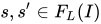

A local optimum is a solution
Alternative Definition
The class PLS is the class containing all problems that can be reduced in polynomial time to the problem Sink-of-DAG[7] (also called Local-Opt [8]):
Given two integers 








Example neighborhood structures
Example neighborhood structures for problems with boolean variables (or bit strings) as solution:
- Flip[2] - The neighborhood of a solution
can be achieved by negating (flipping) one arbitrary input bit
have Hamming distance one:
.
- Kernighan-Lin[2][6] - A solution
is a neighbor of solution
of
is a solution where every bit of
- k-Flip[9] - A solution
between
, so
.
Example neighborhood structures for problems on graphs:
- Swap[10] - A partition
of nodes in a graph is a neighbor of a partition
if
with a node
.
- Kernighan-Lin[1][2] - A partition
with nodes in
. This means the two nodes
gains the highest possible weight, or loses the least possible weight. Note that no node is allowed to be swapped twice. This rule is based on the Kernighan–Lin heuristic for graph partition.
- Fiduccia-Matheyses [1][11] - This neighborhood is similar to the Kernighan-Lin neighborhood structure, it is a greedy sequence of swaps, except that each swap happens in two steps. First the
- FM-Swap[1] - This neighborhood structure is based on the Fiduccia-Mattheyses neighborhood structure. Each solution
has only one neighbor, the partition obtained after the first swap of the Fiduccia-Mattheyses.
The standard Algorithm
Consider the following computational problem:
Given some instance 
Every local search problem can be solved using the following iterative improvement algorithm:[2]
- Use
to find an initial solution
- Use algorithm
to find a better solution
Unfortunately, it generally takes an exponential number of improvement steps to find a local optimum even if the problem
The run time of the standard algorithm is pseudo-polynomial in the number of different costs of a solution.[12]
The space the standard algorithm needs is only polynomial. It only needs to save the current solution
Reductions
A Reduction of one problem to another may be used to show that the second problem is at least as difficult as the first. In particular, a PLS-reduction is used to prove that a local search problem that lies in PLS is also PLS-complete, by reducing a PLS-complete Problem to the one that shall be proven to be PLS-complete.
PLS-reduction
A local search problem 



- if
is an instance of
is an instance of
- if
is a solution for
is a solution for
- if
It is sufficient to only map the local optima of 
PLS-reductions are transitive.[2]
Tight PLS-reduction
Definition Transition graph
The transition graph[6] 

Definition Tight PLS-reduction
A PLS-reduction 

- For every solution
of
of
- If the transition graph
of
to
, and
, but all internal path vertices are outside
and
holds either
or
contains an edge from


Relationship to other complexity classes
PLS lies between the functional versions of P and NP: FP ⊆ PLS ⊆ FNP.[2]
PLS also is a subclass of TFNP,[13] that describes computational problems in which a solution is guaranteed to exist and can be recognized in polynomial time. For a problem in PLS, a solution is guaranteed to exist because the minimum-cost vertex of the entire graph is a valid solution, and the validity of a solution can be checked by computing its neighbors and comparing the costs of each one to another.
It is also proven that if a PLS problem is NP-hard, then NP = co-NP.[2]
PLS-completeness
Definition
A local search problem
- every problem in PLS can be PLS-reduced to
The optimization version of the circuit problem under the Flip neighborhood structure has been shown to be a first PLS-complete problem.[2]
List of PLS-complete Problems
This is an incomplete list of some known problems that are PLS-complete. The problems here are the weighted versions; for example, Max-2SAT/Flip is weighted even though Max-2SAT ordinarily refers to the unweighted version.
 to a problem
  .
Black arrow: Tight PLS-reduction.[4]
.
Black arrow: Tight PLS-reduction.[4]Notation: Problem / Neighborhood structure
- Min/Max-circuit/Flip has been proven to be the first PLS-complete problem.[2]
- Sink-of-DAG is complete by definition.
- Positive-not-all-equal-max-3Sat/Flip has been proven to be PLS-complete via a tight PLS-reduction from Min/Max-circuit/Flip to Positive-not-all-equal-max-3Sat/Flip. Note that Positive-not-all-equal-max-3Sat/Flip can be reduced from Max-Cut/Flip too.[10]
- Positive-not-all-equal-max-3Sat/Kernighan-Lin has been proven to be PLS-complete via a tight PLS-reduction from Min/Max-circuit/Flip to Positive-not-all-equal-max-3Sat/Kernighan-Lin.[1]
- Max-2Sat/Flip has been proven to be PLS-complete via a tight PLS-reduction from Max-Cut/Flip to Max-2Sat/Flip.[1][10]
- Min-4Sat-B/Flip has been proven to be PLS-complete via a tight PLS-reduction from Min-circuit/Flip to Min-4Sat-B/Flip.[9]
- Max-4Sat-B/Flip(or CNF-SAT) has been proven to be PLS-complete via a PLS-reduction from Max-circuit/Flip to Max-4Sat-B/Flip.[14]
- Max-4Sat-(B=3)/Flip has been proven to be PLS-complete via a PLS-reduction from Max-circuit/Flip to Max-4Sat-(B=3)/Flip.[15]
- Max-Uniform-Graph-Partitioning/Swap has been proven to be PLS-complete via a tight PLS-reduction from Max-Cut/Flip to Max-Uniform-Graph-partitioning/Swap.[10]
- Max-Uniform-Graph-Partitioning/Fiduccia-Matheyses is stated to be PLS-complete without proof.[1]
- Max-Uniform-Graph-Partitioning/FM-Swap has been proven to be PLS-complete via a tight PLS-reduction from Max-Cut/Flip to Max-Uniform-Graph-partitioning/FM-Swap.[10]
- Max-Uniform-Graph-Partitioning/Kernighan-Lin has been proven to be PLS-complete via a PLS-reduction from Min/Max-circuit/Flip to Max-Uniform-Graph-Partitioning/Kernighan-Lin.[2] There is also a tight PLS-reduction from Positive-not-all-equal-max-3Sat/Kernighan-Lin to Max-Uniform-Graph-Partitioning/Kernighan-Lin.[1]
- Max-Cut/Flip has been proven to be PLS-complete via a tight PLS-reduction from Positive-not-all-equal-max-3Sat/Flip to Max-Cut/Flip.[1][10]
- Max-Cut/Kernighan-Lin is claimed to be PLS-complete without proof.[6]
- Min-Independent-Dominating-Set-B/k-Flip has been proven to be PLS-complete via a tight PLS-reduction from Min-4Sat-B′/Flip to Min-Independent-Dominating-Set-B/k-Flip.[9]
- Weighted-Independent-Set/Change is claimed to be PLS-complete without proof.[2][10][6]
- Maximum-Weighted-Subgraph-with-property-P/Change is PLS-complete if property P = "has no edges", as it then equals Weighted-Independent-Set/Change. It has also been proven to be PLS-complete for a general hereditary, non-trivial property P via a tight PLS-reduction from Weighted-Independent-Set/Change to Maximum-Weighted-Subgraph-with-property-P/Change.[16]
- Set-Cover/k-change has been proven to be PLS-complete for each k ≥ 2 via a tight PLS-reduction from (3, 2, r)-Max-Constraint-Assignment/Change to Set-Cover/k-change.[17]
- Metric-TSP/k-Change has been proven to be PLS-complete via a PLS-reduction from Max-4Sat-B/Flip to Metric-TSP/k-Change.[15]
- Metric-TSP/Lin-Kernighan has been proven to be PLS-complete via a tight PLS-reduction from Max-2Sat/Flip to Metric-TSP/Lin-Kernighan.[18]
- Local-Multi-Processor-Scheduling/k-change has been proven to be PLS-complete via a tight PLS-reduction from Weighted-3Dimensional-Matching/(p, q)-Swap to Local-Multi-Processor-scheduling/(2p+q)-change, where (2p + q) ≥ 8.[5]
- Selfish-Multi-Processor-Scheduling/k-change-with-property-t has been proven to be PLS-complete via a tight PLS-reduction from Weighted-3Dimensional-Matching/(p, q)-Swap to (2p+q)-Selfish-Multi-Processor-Scheduling/k-change-with-property-t, where (2p + q) ≥ 8.[5]
- Finding a pure Nash Equilibrium in a General-Congestion-Game/Change has been proven PLS-complete via a tight PLS-reduction from Positive-not-all-equal-max-3Sat/Flip to General-Congestion-Game/Change.[19]
- Finding a pure Nash Equilibrium in a Symmetric General-Congestion-Game/Change has been proven to be PLS-complete via a tight PLS-reduction from an asymmetric General-Congestion-Game/Change to symmetric General-Congestion-Game/Change.[19]
- Finding a pure Nash Equilibrium in an Asymmetric Directed-Network-Congestion-Games/Change has been proven to be PLS-complete via a tight reduction from Positive-not-all-equal-max-3Sat/Flip to Directed-Network-Congestion-Games/Change [19] and also via a tight PLS-reduction from 2-Threshold-Games/Change to Directed-Network-Congestion-Games/Change.[20]
- Finding a pure Nash Equilibrium in an Asymmetric Undirected-Network-Congestion-Games/Change has been proven to be PLS-complete via a tight PLS-reduction from 2-Threshold-Games/Change to Asymmetric Undirected-Network-Congestion-Games/Change.[20]
- Finding a pure Nash Equilibrium in a Symmetric Distance-Bounded-Network-Congestion-Games has been proven to be PLS-complete via a tight PLS-reduction from 2-Threshold-Games to Symmetric Distance-Bounded-Network-Congestion-Games.[21]
- Finding a pure Nash Equilibrium in a 2-Threshold-Game/Change has been proven to be PLS-complete via a tight reduction from Max-Cut/Flip to 2-Threshold-Game/Change.[20]
- Finding a pure Nash Equilibrium in Market-Sharing-Game/Change with polynomial bounded costs has been proven to be PLS-complete via a tight PLS-reduction from 2-Threshold-Games/Change to Market-Sharing-Game/Change.[20]
- Finding a pure Nash Equilibrium in an Overlay-Network-Design/Change has been proven to be PLS-complete via a reduction from 2-Threshold-Games/Change to Overlay-Network-Design/Change. Analogously to the proof of asymmetric Directed-Network-Congestion-Game/Change, the reduction is tight.[20]
- Min-0-1-Integer Programming/k-Flip has been proven to be PLS-complete via a tight PLS-reduction from Min-4Sat-B′/Flip to Min-0-1-Integer Programming/k-Flip.[9]
- Max-0-1-Integer Programming/k-Flip is claimed to be PLS-complete because of PLS-reduction to Max-0-1-Integer Programming/k-Flip, but the proof is left out.[9]
- (p, q, r)-Max-Constraint-Assignment
- (3, 2, 3)-Max-Constraint-Assignment-3-partite/Change has been proven to be PLS-complete via a tight PLS-reduction from Circuit/Flip to (3, 2, 3)-Max-Constraint-Assignment-3-partite/Change.[22]
- (2, 3, 6)-Max-Constraint-Assignment-2-partite/Change has been proven to be PLS-complete via a tight PLS-reduction from Circuit/Flip to (2, 3, 6)-Max-Constraint-Assignment-2-partite/Change.[22]
- (6, 2, 2)-Max-Constraint-Assignment/Change has been proven to be PLS-complete via a tight reduction from Circuit/Flip to (6,2, 2)-Max-Constraint-Assignment/Change.[22]
- (4, 3, 3)-Max-Constraint-Assignment/Change equals Max-4Sat-(B=3)/Flip and has been proven to be PLS-complete via a PLS-reduction from Max-circuit/Flip.[15] It is claimed that the reduction can be extended so tightness is obtained.[22]
- Nearest-Colorful-Polytope/Change has been proven to be PLS-complete via a PLS-reduction from Max-2Sat/Flip to Nearest-Colorful-Polytope/Change.[3]
- Stable-Configuration/Flip in a Hopfield network has been proven to be PLS-complete if the thresholds are 0 and the weights are negative via a tight PLS-reduction from Max-Cut/Flip to Stable-Configuration/Flip.[1][10][18]
- Weighted-3Dimensional-Matching/(p, q)-Swap has been proven to be PLS-complete for p ≥9 and q ≥ 15 via a tight PLS-reduction from (2, 3, r)-Max-Constraint-Assignment-2-partite/Change to Weighted-3Dimensional-Matching/(p, q)-Swap.[5]
- The problem Real-Local-Opt (finding the ɛ local optimum of a λ-Lipschitz continuous objective function
and a neighborhood function
) is PLS-complete.[8]
- Finding a local fitness peak in a biological fitness landscapes specified by the NK-model/Point-mutation with K ≥ 2 was proven to be PLS-complete via a tight PLS-reduction from Max-2SAT/Flip.[23]
Relations to other complexity classes
Fearnley, Goldberg, Hollender and Savani[24] proved that a complexity class called CLS (Continuous Local Search) is equal to the intersection of PPAD and PLS.
Further reading
- Equilibria, fixed points, and complexity classes: a survey.[25]
References
- Yannakakis, Mihalis (2009), "Equilibria, fixed points, and complexity classes", Computer Science Review, 3 (2): 71–85, CiteSeerX 10.1.1.371.5034, doi:10.1016/j.cosrev.2009.03.004.
- 1 2 3 4 5 6 7 8 9 10 11 12 Yannakakis, Mihalis (2003). Local search in combinatorial optimization - Computational complexity. Princeton University Press. pp. 19–55. ISBN 9780691115221.
- 1 2 3 4 5 6 7 8 9 10 11 12 13 14 15 16 Johnson, David S; Papadimitriou, Christos H; Yannakakis, Mihalis (1988). "How easy is local search?". Journal of Computer and System Sciences. 37 (1): 79–100. doi:10.1016/0022-0000(88)90046-3.
- 1 2 Mulzer, Wolfgang; Stein, Yannik (14 March 2018). "Computational Aspects of the Colorful Caratheodory Theorem". Discrete & Computational Geometry. 60 (3): 720–755. arXiv:1412.3347. Bibcode:2014arXiv1412.3347M. doi:10.1007/s00454-018-9979-y. S2CID 254024141.
- 1 2 Borzechowski, Michaela. "The complexity class Polynomial Local Search (PLS) and PLS-complete problems" (PDF).
- 1 2 3 4 Dumrauf, Dominic; Monien, Burkhard; Tiemann, Karsten (2009). "Multiprocessor Scheduling is PLS-Complete". System Sciences, 2009. HICSS'09. 42nd Hawaii International Conference on: 1–10.
- 1 2 3 4 5 6 7 Michiels, Wil; Aarts, Emile; Korst, Jan (2010). Theoretical aspects of local search. Springer Science & Business Media. ISBN 9783642071485.
- ↑ Fearnley, John; Gordon, Spencer; Mehta, Ruta; Savani, Rahul (December 2020). "Unique end of potential line". Journal of Computer and System Sciences. 114: 1–35. arXiv:1811.03841. doi:10.1016/j.jcss.2020.05.007.
- 1 2 Daskalakis, Constantinos; Papadimitriou, Christos (23 January 2011). "Continuous Local Search". Proceedings of the Twenty-Second Annual ACM-SIAM Symposium on Discrete Algorithms: 790–804. doi:10.1137/1.9781611973082.62. hdl:1721.1/73982. ISBN 978-0-89871-993-2. S2CID 2056144.
- 1 2 3 4 5 Klauck, Hartmut (1996). "On the hardness of global and local approximation". Proceedings of the 5th Scandinavian Workshop on Algorithm Theory: 88–99.
- 1 2 3 4 5 6 7 8 9 Schäffer, Alejandro A.; Yannakakis, Mihalis (February 1991). "Simple Local Search Problems that are Hard to Solve". SIAM Journal on Computing. 20 (1): 56–87. doi:10.1137/0220004.
- ↑ Fiduccia, C. M.; Mattheyses, R. M. (1982). "A Linear-time Heuristic for Improving Network Partitions". Proceedings of the 19th Design Automation Conference: 175–181. ISBN 9780897910200.
- ↑ Angel, Eric; Christopoulos, Petros; Zissimopoulos, Vassilis (2014). Paradigms of Combinatorial Optimization: Problems and New Approaches - Local Search: Complexity and Approximation (2 ed.). John Wiley & Sons, Inc., Hoboken. pp. 435–471. doi:10.1002/9781119005353.ch14. ISBN 9781119005353.
- ↑ Megiddo, Nimrod; Papadimitriou, Christos H (1991). "On total functions, existence theorems and computational complexity". Theoretical Computer Science. 81 (2): 317–324. CiteSeerX 10.1.1.75.4797. doi:10.1016/0304-3975(91)90200-L.
- ↑ Krentel, M. (1 August 1990). "On Finding and Verifying Locally Optimal Solutions". SIAM Journal on Computing. 19 (4): 742–749. doi:10.1137/0219052. ISSN 0097-5397.
- 1 2 3 Krentel, Mark W. (1989). "Structure in locally optimal solutions". 30th Annual Symposium on Foundations of Computer Science. pp. 216–221. doi:10.1109/SFCS.1989.63481. ISBN 0-8186-1982-1. S2CID 32686790.
- ↑ Shimozono, Shinichi (1997). "Finding optimal subgraphs by local search". Theoretical Computer Science. 172 (1): 265–271. doi:10.1016/S0304-3975(96)00135-1.
- ↑ Dumrauf, Dominic; Süß, Tim (2010). "On the Complexity of Local Search for Weighted Standard Set Problems". CiE 2010: Programs, Proofs, Processes. Lecture Notes in Computer Science. Vol. 6158. Springer, Berlin, Heidelberg. pp. 132–140. CiteSeerX 10.1.1.762.6801. doi:10.1007/978-3-642-13962-8_15. ISBN 978-3-642-13961-1. S2CID 14099014.
- 1 2 Papadimitriou, C.H.; Schäffer, A. A.; Yannakakis, M. (1990). "On the complexity of local search". Proceedings of the twenty-second annual ACM symposium on Theory of computing - STOC '90. pp. 438–445. doi:10.1145/100216.100274. ISBN 0897913612. S2CID 16877206.
- 1 2 3 Fabrikant, Alex; Papadimitriou, Christos; Talwar, Kunal (2004). "The complexity of pure Nash equilibria". Proceedings of the thirty-sixth annual ACM symposium on Theory of computing. ACM. pp. 604–612. CiteSeerX 10.1.1.3.7861. doi:10.1145/1007352.1007445. ISBN 978-1581138528. S2CID 1037326.
- 1 2 3 4 5 Ackermann, Heiner; Röglin, Heiko; Vöcking, Berthold (2008). "On the Impact of Combinatorial Structure on Congestion Games". J. ACM. 55 (6): 25:1–25:22. CiteSeerX 10.1.1.634.4913. doi:10.1145/1455248.1455249. ISSN 0004-5411. S2CID 3070710.
- ↑ Yang, Yichen; Jia, Kai; Rinard, Martin (2022). "On the Impact of Player Capability on Congestion Games". Algorithmic Game Theory. Lecture Notes in Computer Science. Vol. 13584. pp. 311–328. arXiv:2205.09905. doi:10.1007/978-3-031-15714-1_18. ISBN 978-3-031-15713-4.
- 1 2 3 4 Dumrauf, Dominic; Monien, Burkhard (2013). "On the PLS-complexity of Maximum Constraint Assignment". Theor. Comput. Sci. 469: 24–52. doi:10.1016/j.tcs.2012.10.044. ISSN 0304-3975.
- ↑ Kaznatcheev, Artem (2019). "Computational Complexity as an Ultimate Constraint on Evolution". Genetics. 212 (1): 245–265. doi:10.1534/genetics.119.302000. PMC 6499524. PMID 30833289.
- ↑ Fearnley, John; Goldberg, Paul; Hollender, Alexandros; Savani, Rahul (2022-12-19). "The Complexity of Gradient Descent: CLS = PPAD ∩ PLS". Journal of the ACM. 70 (1): 7:1–7:74. arXiv:2011.01929. doi:10.1145/3568163. ISSN 0004-5411. S2CID 263706261.
- ↑ Yannakakis, Mihalis (2009-05-01). "Equilibria, fixed points, and complexity classes". Computer Science Review. 3 (2): 71–85. arXiv:0802.2831. doi:10.1016/j.cosrev.2009.03.004. ISSN 1574-0137.