Velocity
In isotropic and homogeneous solids, a P wave travels in a straight line longitudinally; thus, the particles in the solid vibrate along the axis of propagation (the direction of motion) of the wave energy. The velocity of P waves in that kind of medium is given by
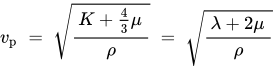 where K is the bulk modulus (the modulus of incompressibility), μ is the shear modulus (modulus of rigidity, sometimes denoted as G and also called the second Lamé parameter), ρ is the density of the material through which the wave propagates, and λ is the first Lamé parameter.
In typical situations in the interior of the Earth, the density ρ usually varies much less than K or μ, so the velocity is mostly "controlled" by these two parameters.
The elastic moduli P wave modulus,  , is defined so that
 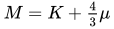 and thereby

Typical values for P wave velocity in earthquakes are in the range 5 to 8 km/s. The precise speed varies according to the region of the Earth's interior, from less than 6 km/s in the Earth's crust to 13.5 km/s in the lower mantle, and 11 km/s through the inner core.[6]
Velocity in common rock types[7]
| Rock Type |
Velocity [m/s] |
Velocity [ft/s] |
| Unconsolidated sandstone | 4,600–5,200 | 15,000–17,000 |
| Consolidated sandstone | 5,800 | 19,000 |
| Shale | 1,800–4,900 | 6,000–16,000 |
| Limestone | 5,800–6,400 | 19,000–21,000 |
| Dolomite | 6,400–7,300 | 21,000–24,000 |
| Anhydrite | 6,100 | 20,000 |
| Granite | 5,800–6,100 | 19,000–20,000 |
| Gabbro | 7,200 | 23,600 |
|
Geologist Francis Birch discovered a relationship between the velocity of P waves and the density of the material the waves are traveling in:
 which later became known as Birch's law. (The symbol a() is an empirically tabulated function, and b is a constant.)


