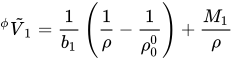
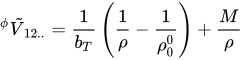
Relation to other compositional quantities
In what follows, the solvent may be given the same treatment as the other constituents of the solution, such that the molality of the solvent of an n-solute solution, say b0, is found to be nothing more than the reciprocal of its molar mass, M0 (expressed in the unit kg/mol):
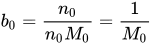 .
.
For the solutes the expression of molalities is similar:
 .
.
The expressions linking molalities to mass fractions and mass concentrations contain the molar masses of the solutes Mi:
 .
.
Similarly the equalities below are obtained from the definitions of the molalities and of the other compositional quantities.
The mole fraction of solvent can be obtained from the definition by dividing the numerator and denominator to the amount of solvent n0:
 .
.
Then the sum of ratios of the other mole amounts to the amount of solvent is substituted with expressions from below containing molalities:

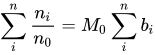
giving the result
 .
.
Mass fraction
The conversions to and from the mass fraction, w1, of the solute in a single-solute solution are
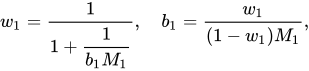
where b1 is the molality and M1 is the molar mass of the solute.
More generally, for an n-solute/one-solvent solution, letting bi and wi be, respectively, the molality and mass fraction of the i-th solute,
 ,
,
where Mi is the molar mass of the ith solute, and w0 is the mass fraction of the solvent, which is expressible both as a function of the molalities as well as a function of the other mass fractions,
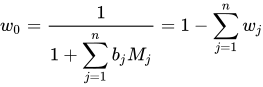 .
.
Substitution gives:
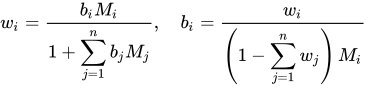 .
.
Mole fraction
The conversions to and from the mole fraction, x1 mole fraction of the solute in a single-solute solution are
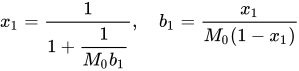 ,
,
where M0 is the molar mass of the solvent.
More generally, for an n-solute/one-solvent solution, letting xi be the mole fraction of the ith solute,
 ,
,
where x0 is the mole fraction of the solvent, expressible both as a function of the molalities as well as a function of the other mole fractions:
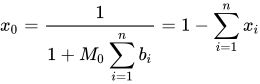 .
.
Substitution gives:
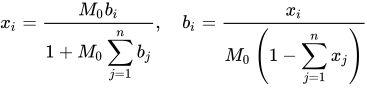 .
.
Molar concentration (molarity)
The conversions to and from the molar concentration, c1, for one-solute solutions are
 ,
,
where ρ is the mass density of the solution, b1 is the molality, and M1 is the molar mass (in kg/mol) of the solute.
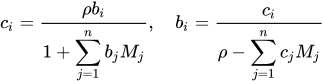
For solutions with n solutes, the conversions are
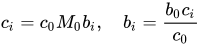 ,
,
where the molar concentration of the solvent c0 is expressible both as a function of the molalities as well as a function of the other molarities:
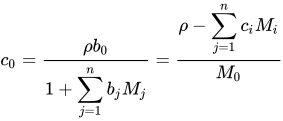 .
.
Substitution gives:
 ,
,
Mass concentration
The conversions to and from the mass concentration, ρsolute, of a single-solute solution are
 ,
,
or
 ,
,
where ρ is the mass density of the solution, b1 is the molality, and M1 is the molar mass of the solute.
For the general n-solute solution, the mass concentration of the ith solute, ρi, is related to its molality, bi, as follows:
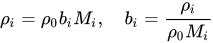 ,
,
where the mass concentration of the solvent, ρ0, is expressible both as a function of the molalities as well as a function of the other mass concentrations:
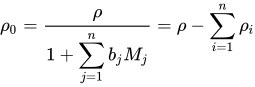 .
.
Substitution gives:
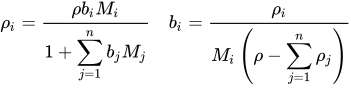 .
.
Equal ratios
Alternatively, one may use just the last two equations given for the compositional property of the solvent in each of the preceding sections, together with the relationships given below, to derive the remainder of properties in that set:
 ,
,
where i and j are subscripts representing all the constituents, the n solutes plus the solvent.
Example of conversion
An acid mixture consists of 0.76, 0.04, and 0.20 mass fractions of 70% HNO3, 49% HF, and H2O, where the percentages refer to mass fractions of the bottled acids carrying a balance of H2O. The first step is determining the mass fractions of the constituents:
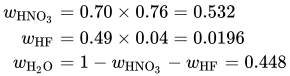 .
.
The approximate molar masses in kg/mol are
 .
.
First derive the molality of the solvent, in mol/kg,
 ,
,
and use that to derive all the others by use of the equal ratios:
 .
.
Actually, bH2O cancels out, because it is not needed. In this case, there is a more direct equation: we use it to derive the molality of HF:
 .
.
The mole fractions may be derived from this result:
 ,
, ,
, .
.
Molalities of a ternary or multicomponent solution
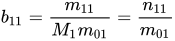
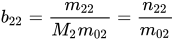
The molalities of solutes b1, b2 in a ternary solution obtained by mixing two binary aqueous solutions with different solutes (say a sugar and a salt or two different salts) are different than the initial molalities of the solutes bii in their binary solutions:
 ,
,
 ,
,
 ,
,
 .
.
The content of solvent in mass fractions w01 and w02 from each solution of masses ms1 and ms2 to be mixed as a function of initial molalities is calculated. Then the amount (mol) of solute from each binary solution is divided by the sum of masses of water after mixing:
 ,
,
 .
.
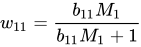
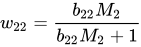
Mass fractions of each solute in the initial solutions w11 and w22
are expressed as a function of the initial molalities b11, b22:
 ,
,
 .
.
These expressions of mass fractions are substituted in the final molalitaties:
 ,
,
 .
.
The results for a ternary solution can be extended to a multicomponent solution (with more than two solutes).
From the molalities of the binary solutions
The molalities of the solutes in a ternary solution can be expressed also from molalities in the binary solutions and their masses:
 ,
,
 .
.
The binary solution molalities are:
,
.
The masses of the solutes determined from the molalities of the solutes and the masses of water can be substituted in the expressions of the masses of solutions:
 .
.
Similarly for the mass of the second solution:
 .
.
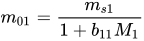
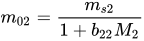
One can obtain the masses of water present in the sum from the denominator of the molalities of the solutes in the ternary solutions as functions of binary molalities and masses of solution:
 ,
,
 .
.
Thus the ternary molalities are:
 ,
,
 .
.
For solutions with three or more solutes the denominator is a sum of the masses of solvent in the n binary solutions which are mixed:
 ,
,
 ,
,
 .
.