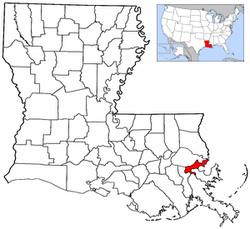
Orleans Parish (French: Paroisse d'Orléans; Spanish: Parroquia de Orleans) is a parish of the U.S. state of Louisiana. Since 1870, the parish has been coterminous with the city of New Orleans, and the parish and city are largely governed as a single consolidated city.
On April 10, 1805, the Territory of Orleans was divided into 12 counties, including Orleans County. On April 14, 1807, the territory was also divided into 19 civil parishes while keeping the previous system of counties intact. Based on the boundaries and names of earlier ecclesiastical parishes, Orleans County was divided into Orleans, St. Bernard, and Plaquemines parishes, with New Orleans inside the Orleans Parish limits. The county remained responsible for elections and taxation, while the parishes took over responsibility for civil, criminal, probate, and other judicial matters. The system of counties was never explicitly abolished, but the Louisiana Constitution of 1845 dropped any reference to counties and gave their powers to the parishes.[1]
At its establishment, the Orleans Parish government was led by a police jury, which had only limited authority within the city of New Orleans. In 1822, when the police jury began to be elected popularly, the New Orleans City Council was granted a veto over fiscal matters. In 1840, the parish was divided in two along the Mississippi River. A second police jury was established and given authority over Algiers. It was formally named the Police Jury of the Parish of Orleans on the right bank of the River Mississippi. By 1846, the original police jury had become inactive and was abolished, resulting in the consolidation of the left bank with New Orleans.[2][3] In 1870, the remainder of Orleans Parish was consolidated when the city became coextensive with the parish.[4]
Orleans Parish originally extended as far west as present-day Kenner and as far south as Grand Isle. In 1824, uncertainty over the relative locations of Grand Isle and Cheniere Caminada resulted in a territorial dispute between Orleans Parish and Lafourche Interior Parish (now Lafourche). The dispute was resolved in 1825 with the creation of Jefferson Parish, which included these areas.[1]
In 1852, New Orleans annexed the city of LaFayette (now Faubourg Lafayette) while keeping the parish boundaries unchanged, causing the city to extend into Jefferson Parish.[1] However, subsequent annexations of Jefferson in 1870 and Carrollton in 1874 included the redrawing of both city and parish boundaries.[1][6] Since 1870, Orleans Parish has been coextensive with New Orleans. In 1979, parish boundaries through Lake Pontchartrain were defined, resulting in a gain of territory for the parish.[1]
Population given for Orleans Parish, including the city of New Orleans, before New Orleans absorbed suburbs and rural areas of Orleans Parish in 1874, since which time the city and parish have been coextensive. For more recent population figures, see New Orleans §Demographics. Source: U.S. Decennial Census[7]
2020 census
As of the 2020 census, the parish had a population of 383,997, a median age of 36.2 years, 20.3% of residents under the age of 18, and 14.7% of residents 65 years of age or older; for every 100 females there were 89.3 males, and for every 100 females age 18 and over there were 86.2 males age 18 and over.[8]
99.6% of residents lived in urban areas, while 0.4% lived in rural areas.[10]
There were 165,125 households in the parish, of which 25.5% had children under the age of 18 living in them. Of all households, 26.4% were married-couple households, 24.9% were households with a male householder and no spouse or partner present, and 40.7% were households with a female householder and no spouse or partner present. About 38.3% of all households were made up of individuals and 11.5% had someone living alone who was 65 years of age or older.[8]
There were 193,840 housing units, of which 14.8% were vacant. Among occupied housing units, 45.5% were owner-occupied and 54.5% were renter-occupied. The homeowner vacancy rate was 2.4% and the rental vacancy rate was 9.5%.[8]
Racial and ethnic composition
Orleans Parish, Louisiana – Racial and ethnic composition Note: the US Census treats Hispanic/Latino as an ethnic category. This table excludes Latinos from the racial categories and assigns them to a separate category. Hispanics/Latinos may be of any race.
Since consolidation, Orleans Parish has retained a nominal, sui generis status under Louisiana state law that guarantees the city's home rule. It has been effectively abolished as a distinct governmental unit, and the United States Census Bureau considers New Orleans and Orleans Parish to be a single consolidated city. However, various parish offices remain with a degree of independence from the city government, while in other matters, the city represents the parish. Examples of parish entities include the Orleans Parish School Board, the Orleans Parish Sheriff's Office, and formerly the Orleans Levee Board.[21]
United States presidential election results for Orleans Parish, Louisiana[22]
Orleans Parish and the city of New Orleans operate as a merged city-parish government.[23] The original city was composed of what are now the 1st to 9th wards. In 1852, the city of Lafayette, including the Garden District, was added as the 10th and 11th wards. In 1870, Jefferson City, including Faubourg Bouligny and much of the Audubon and University areas, was annexed as the 12th, 13th, and 14th wards. Algiers, on the west bank of the Mississippi, was also annexed in 1870, becoming the 15th ward.
The Orleans Parish Civil Sheriff's Office serves papers involving lawsuits, provides court security, and operates the city's correctional facilities, including Orleans Parish Prison. The sheriff's office shares legal jurisdiction with the New Orleans Police Department and provides it with backup on an as-needed basis. Before 2010, New Orleans (and all other parishes in Louisiana) had separate criminal and civil sheriff's offices, corresponding to the separate criminal and civil courts: these were merged in 2010.[24]As of 2024[update] the sheriff is Susan Hutson, who defeated 17-year incumbent Marlin Gusman in the 2021 New Orleans City Election.[25][26]
↑"Pines Village Neighborhood Snapshot". Greater New Orleans Community Data Center. New Orleans: Greater New Orleans Nonprofit Knowledge Works. Retrieved June 20, 2017.