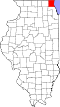
Land speculators moved into the area south of what is now the city of Waukegan in the 1890s. Industrial development began almost immediately with a railroad depot being set up in 1892; most notable was the arrival of the Washburn and Moen Manufacturing Company, a major barbed wire maker.[4]
The settlement was incorporated as a village in 1895 and as a city in 1909. In 1911, a naval training area was created, the present Great Lakes Naval Training Center, currently the only "boot camp" for Navy enlisted personnel after the closure of facilities in Florida, California, and Houston, MS.
A Veteran's Administration hospital went into service in 1926. This facility was also threatened with closure in recent years but has been retained on condition of a merger with the Naval Hospital.
Historically, North Chicago was known for large populations of Eastern European immigrants. With the onset of the "Great Migration", large numbers of African Americans arrived in the city from states such as Arkansas and Alabama, and toward the end of the 20th century, became the best known demographic group. Housing was segregated in the mid-20th century, and until as late as 1957 the African-American section of town lacked sewers and paved roads.[5]Latinos have arrived in significant numbers, particularly from Mexico, and now form the largest racial/ethnic group in the city (36% as of 2020), just as they do in Waukegan to the north (60% in 2020). North Chicago may have over time been the most diverse and multicultural municipality in Lake County.
Companies such as Washburn and Moen played a significant role in dividing North Chicago based on ethnicity. Workers were relocated from the Worcester plant, and later on, Swedes, Finns, and other Eastern Europeans were brought in. In the northern part of North Chicago, Slovaks, who referred to the area as "Kompanija", founded the Mother of God Roman Catholic Church. Moving further south, Polish residents established Holy Rosary Catholic Church, while German and Irish residents set up schools and churches in the area.[6]
At one time, Navy personnel were a major part of the scene in North Chicago, both the "swabbies" (enlisted men) and the officers. Now, with the degeneration of "the Strip", or entertainment district along several blocks of Sheridan Road, sailors are rarely seen north of the railroad trestle. In the fall of 2007, the city finished demolishing the buildings on Sheridan Road between Martin Luther King Drive and the railroad trestle to the north, within the framework of a new development project involving tax increment financing.
According to the 2021 census gazetteer files, North Chicago has a total area of 8.02 square miles (20.77km2), of which 8.00 square miles (20.72km2) (or 99.75%) is land and 0.02 square miles (0.05km2) (or 0.25%) is water.[8]
North Chicago includes a Lake County Forest Preserve unit, the Greenbelt Cultural Center and Forest Preserve. The City of North Chicago includes a beach within its limits called Foss Park Beach, which is owned and maintained by the Foss Park District, which is named after Former Congressman George Edmund Foss. [9]
North Chicago city, Illinois – Racial and ethnic composition Note: the US Census treats Hispanic/Latino as an ethnic category. This table excludes Latinos from the racial categories and assigns them to a separate category. Hispanics/Latinos may be of any race.
As of the 2020 census, North Chicago had a population of 30,759. The population density was 3,837.68 inhabitants per square mile (1,481.74/km2). The median age was 23.4 years. 18.1% of residents were under the age of 18 and 6.1% of residents were 65 years of age or older. For every 100 females there were 148.9 males, and for every 100 females age 18 and over there were 163.7 males age 18 and over.[14][15]
100.0% of residents lived in urban areas, while 0.0% lived in rural areas.[16]
There were 6,834 households and 4,413 families in North Chicago; 39.1% of households had children under the age of 18 living in them. Of all households, 35.5% were married-couple households, 24.2% were households with a male householder and no spouse or partner present, and 33.2% were households with a female householder and no spouse or partner present. About 29.0% of all households were made up of individuals and 8.5% had someone living alone who was 65 years of age or older.[14]
There were 7,897 housing units, of which 13.5% were vacant. The homeowner vacancy rate was 1.5% and the rental vacancy rate was 8.9%.[14]
North Chicago census figures include the Great Lakes Naval Training Center.
Government
The City of North Chicago is a home rule municipality governed by a Mayor and a seven-member City Council. The Mayor and Aldermen are elected to four-year terms with no limit on the number of terms they may serve. Additionally, the City elects a City Clerk and a City Treasurer, both of whom also serve four-year, indefinite terms. [17][18][19]
North Chicago, by Charles M. Leeks and Mary L. Robinson, in: Local Community Fact Book: Chicago Metropolitan Area (1990). Chicago: The Chicago Fact Book Consortium, Dept of Sociology, University of Illinois at Chicago, c1995.
North Chicago, IL, by Wallace Best, in: The Encyclopedia of Chicago. Chicago: University of Chicago Press, c2004.irac