In linear algebra, mutual coherence (or simply coherence) measures the maximum similarity between any two columns of a matrix, defined as the largest absolute value of their cross-correlations.[1][2] First explored by David Donoho and Xiaoming Huo in the late 1990s for pairs of orthogonal bases,[3] it was later expanded by Donoho and Michael Elad in the early 2000s to study sparse representations[4]—where signals are built from a few key components in a larger set.
In signal processing, mutual coherence is widely used to assess how well algorithms like matching pursuit and basis pursuit can recover a signal’s sparse representation from a collection with extra building blocks, known as an overcomplete dictionary.[1][2][5]
Joel Tropp extended this idea with the Babel function, which applies coherence from one column to a group, equaling mutual coherence for two columns while broadening its use for larger sets with any number of columns.[6]
Formal definition
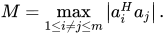
Formally, let be the columns of the matrix A, which are assumed to be normalized such that The mutual coherence of A is then defined as[1][2]
123Donoho, D.L.; M. Elad; V.N. Temlyakov (January 2006). "Stable recovery of sparse overcomplete representations in the presence of noise". IEEE Transactions on Information Theory. 52 (1): 6–18. doi:10.1109/TIT.2005.860430. S2CID14813938.
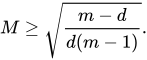
↑Welch, L. R. (1974). "Lower bounds on the maximum cross-correlation of signals". IEEE Transactions on Information Theory. 20 (3): 397–399. doi:10.1109/tit.1974.1055219.