ENSIKLOPEDIA
Moveable type printing press
| Printing press | |
|---|---|
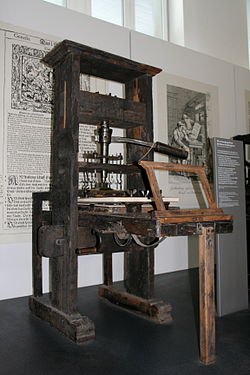
 A recreated Gutenberg press at the International Printing Museum in Carson, California | |
| Classification | Machine |
| Application | Printing |
| Inventor | Johannes Gutenberg |
| Invented | 1440 (586 years ago) (1440) |
| Part of a series on the | ||||||||||||||||||||||||||||||||||||||||||||||||||||||||||||||||
| History of printing | ||||||||||||||||||||||||||||||||||||||||||||||||||||||||||||||||
|---|---|---|---|---|---|---|---|---|---|---|---|---|---|---|---|---|---|---|---|---|---|---|---|---|---|---|---|---|---|---|---|---|---|---|---|---|---|---|---|---|---|---|---|---|---|---|---|---|---|---|---|---|---|---|---|---|---|---|---|---|---|---|---|---|
.jpg) | ||||||||||||||||||||||||||||||||||||||||||||||||||||||||||||||||
|
Techniques
|
||||||||||||||||||||||||||||||||||||||||||||||||||||||||||||||||
A printing press is a mechanical device for applying pressure to an inked surface resting upon a print medium (such as paper or cloth), thereby transferring the ink. It marked a dramatic improvement on earlier printing methods, in which the medium was brushed or rubbed repeatedly to achieve the transfer of ink. The invention and global spread of the printing press was one of the most influential events in the second millennium.
In Germany, around 1440, the goldsmith Johannes Gutenberg invented the movable-type printing press, which started the Printing Revolution. Modeled on the design of existing screw presses, a single Renaissance printing press could produce up to 3,600 pages per workday, compared to forty by hand-printing and a few by hand-copying. Gutenberg's newly devised hand mould made possible the rapid creation of metal movable type in large quantities. From Mainz, the press spread within several decades to over 200 cities in a dozen European countries. By 1500, presses in operation throughout Western Europe had produced more than 20 million volumes. The operation of a press became synonymous with the enterprise of printing and lent its name to a new medium of expression and communication, "the press".
The spread of the printing press introduced the era of mass communication, which altered the structure of European society. The relatively unrestricted circulation of information and ideas transcended borders, spread rapidly during the Reformation, and supported the collaborative networks of the Scientific Revolution. A sharp increase in literacy broke the monopoly of the literate elite on education and learning and strengthened the emerging middle class. As works were increasingly published in vernacular languages rather than Latin, printed texts helped to standardize the spelling and syntax of national languages.
Although the basic design of the wooden handpress remained largely unchanged for more than three centuries, the Industrial Revolution brought fundamental change. By 1800, Lord Stanhope had built the first press entirely from cast iron, doubling the printed area and output. In the 1810s, Friedrich Koenig introduced steam power and the rotary motion of cylinders, and his presses were adopted by The Times in 1814. The steam-powered rotary printing press, invented by Richard M. Hoe in 1843, allowed millions of copies of a page to be produced in a single day. During the twentieth century, offset printing, phototypesetting, and digital printing successively replaced the letterpress method for most commercial applications.
History
Economic conditions and intellectual climate

The economic and cultural changes of late medieval Europe helped to create conditions in which Gutenberg's printing press could succeed commercially. The growth of trade and commerce had expanded the urban middle class, while the multiplication of universities from the twelfth century onward had increased demand for books. Hand-copying was slow and expensive, and by the fifteenth century the supply of manuscripts fell far short of this growing demand.[1]
Technological factors
Gutenberg's press combined four pre-existing technologies that had each reached a level of development sufficient for printing by the mid-fifteenth century: the screw press, movable type, the codex book format, and mechanized paper production. Gutenberg integrated these into a single working system and added a number of innovations of his own, including a hand mould for casting type and an oil-based ink suited to metal type.[2]

The first of these was the screw press, which allowed direct pressure to be applied on a flat plane. It was already of great antiquity in Gutenberg's time and was used for a wide range of tasks.[3] Introduced in the 1st century AD by the Romans, it was commonly employed in agricultural production for pressing grapes for wine and olives for oil.[4] The device was also used from very early on in urban contexts as a cloth press for printing patterns.[5] Gutenberg may have also been inspired by the paper presses which had spread through the German lands since the late 14th century and which worked on the same mechanical principles.[6]
Gutenberg adopted the basic design, thereby mechanizing the printing process.[7] Printing, however, put a demand on the machine quite different from pressing. Gutenberg adapted the construction so that the pressing power exerted by the platen on the paper was now applied both evenly and with the required sudden elasticity. To speed up the printing process, he introduced a movable undertable with a plane surface on which the sheets could be swiftly changed.[8]

The second element, movable type, existed in some form prior to 15th century Europe; sporadic evidence that the typographical principle, the idea of creating a text by reusing individual characters, was known and had been cropping up since the 12th century and possibly before (the oldest known application dating back as far as the Phaistos disc). The first movable type was invented by Chinese engineer Bi Sheng in the 11th century during the Song dynasty, and a book dating to 1193 recorded the first copper movable type.[9]
Woodblock printing remained the dominant technique in East Asia. The oldest printed book using metal movable type was the Jikji, printed in Korea in 1377 during the Goryeo era. Other notable examples include the Prüfening inscription from Germany, letter tiles from England and Altarpiece of Pellegrino II in Italy.[10] However, the various techniques employed (imprinting, punching and assembling individual letters) did not have the refinement and efficiency needed to become widely accepted. Tsuen-Hsuin and Needham, and Briggs and Burke suggest that the movable-type printing in China and Korea was rarely employed, in part because the large number of characters in logographic writing systems made movable type less practical than in alphabetic systems.[11][12] Gutenberg's use of the Latin alphabet was a practical advantage in this respect because it allowed the type-setter to represent any text with a relatively small set of characters.[13]
The third element was the codex book format, which had originated in the Roman period.[14] Considered the most important advance in the history of the book prior to printing itself, the codex had completely replaced the ancient scroll at the onset of the Middle Ages (AD 500).[15] The codex holds considerable practical advantages over the scroll format: it is more convenient to read (by turning pages), more compact, and less costly, and both recto and verso sides could be used for writing or printing, unlike the scroll.[16]

The fourth element was paper. Medieval papermakers had succeeded in mechanizing paper manufacture: the introduction of water-powered paper mills, the first certain evidence of which dates to 1282,[17] allowed for a massive expansion of production and replaced the laborious handcraft characteristic of both Chinese[18] and Muslim papermaking.[19] Papermaking centers began to multiply in the late 13th century in Italy, reducing the price of paper to one-sixth of parchment and then falling further. Papermaking centers reached Germany a century later.[20]
Despite this it appears that the final breakthrough of paper depended just as much on the rapid spread of movable-type printing.[21] Codices of parchment, which in terms of quality is superior to any other writing material,[22] still had a substantial share in Gutenberg's edition of the 42-line Bible.[23] After much experimentation, Gutenberg managed to overcome the difficulties which traditional water-based inks caused by soaking the paper, and found the formula for an oil-based ink suitable for high-quality printing with metal type.[24]
Gutenberg's press
_(14777458662).jpg)
Gutenberg's work on the printing press began in approximately 1436 when he partnered with Andreas Dritzehn, who had previously instructed in gem-cutting, and Andreas Heilmann, owner of a paper mill.[25] However, it was not until a 1439 lawsuit against Gutenberg that an official record existed; witnesses' testimony discussed Gutenberg's types, an inventory of metals (including lead), and his type molds.[25]
Having previously worked as a professional goldsmith, Gutenberg made skillful use of the knowledge of metals he had learned as a craftsman. He was the first to make type from an alloy of lead, tin, and antimony, which was critical for producing durable type that produced high-quality printed books and proved to be much better suited for printing than all other known materials. To create these lead types, Gutenberg used what is considered one of his most ingenious inventions,[25] a special matrix enabling the quick and precise molding of new type blocks from a uniform template. His type case is estimated to have contained around 290 separate letter boxes, most of which were required for special characters, ligatures, punctuation marks, and so forth.[26]
Gutenberg is also credited with the introduction of an oil-based ink which was more durable than the previously used water-based inks. As printing material he used both paper and vellum (high-quality parchment). In the Gutenberg Bible, Gutenberg made a trial of color printing for a few of the page headings, present only in some copies.[27] A later work, the Mainz Psalter of 1453, presumably designed by Gutenberg but published under the imprint of his successors Johann Fust and Peter Schöffer, had elaborate red and blue printed initials.[28]
Function and approach


A printing press, in its classical form, is a standing mechanism, ranging from 5 to 7 feet (1.5 to 2.1 m) long, 3 feet (0.91 m) wide, and 7 feet (2.1 m) tall.[30] A compositor set the small individual metal letters known as type into the desired lines of text.[31] Several lines were arranged at once and placed in a wooden frame known as a galley. Once the correct number of pages were composed, the galleys were laid face up in a frame called a forme,[31] which was placed onto a flat stone known as the bed.[31]
The type was inked using two ink balls, pads of leather stuffed with wool or horsehair and mounted on wooden handles. The leather was usually sheepskin, though calfskin and dogskin were also used.[31] The ink was distributed evenly by pressing the two balls together before applying them to the type. A sheet of dampened paper was placed on the tympan and held in position with small pins. A frisket, a thin frame covered in paper with cut-out apertures matching the type, was folded over the sheet to protect the margins from ink.[31]
The tympan and frisket were then folded down so that the paper lay on the inked type. The bed was rolled under the platen using a windlass mechanism operated by a small handle called the rounce. The impression was made by turning a long handle known as the bar, which drove a screw to press the platen onto the paper.[31] The springiness of the tympan assembly caused the bar to spring back after each pull. The bed was then wound out, the tympan and frisket opened, and the printed sheet removed. Such presses were worked entirely by hand until the development of iron presses after around 1800, some of which could be operated by steam power.[32]
Printing revolution
The printing revolution occurred when the spread of the printing press facilitated the wide circulation of information and ideas, a process that Eisenstein termed an "agent of change" in the societies that it reached.[33] Its consequences included the mass production of books, shifts in reading habits and the relationship between authors and texts, the decline of Latin as the language of scholarship, and new economic patterns in the book trade.[33]
Mass production and spread in Europe


The invention of mechanical movable type printing led to a rapid increase of printing activities across Europe within only a few decades. Demand for bibles and other religious literature was one of the main drivers of the very rapid initial expansion of printing.[35] From a single print shop in Mainz, Germany, printing had spread to around 270 cities in Central, Western and Eastern Europe by the end of the 15th century.[36] As early as 1480, there were printers active in 110 different places in Germany, Italy, France, Spain, the Netherlands, Belgium, Switzerland, England, Bohemia and Poland.[37] The historians Lucien Febvre and Henri-Jean Martin conclude that by this date the printed book was in universal use in Europe.[38]
In Italy, a center of early printing, print shops had been established in 77 cities and towns by 1500. At the end of the following century, 151 locations in Italy had seen at one time printing activities, with a total of nearly three thousand printers known to be active. Despite this proliferation, printing centers soon emerged; thus, one third of the Italian printers published in Venice.[39]
By 1500, the printing presses in operation throughout Western Europe had already produced more than twenty million copies.[40] In the following century, their output rose tenfold to an estimated 150 to 200 million copies.[40] European printing presses of around 1600 were capable of producing between 1,500[41] and 3,600 impressions per workday.[29] By comparison, Far Eastern printing, where the back of the paper was manually rubbed to the page,[42] did not exceed an output of forty pages per day.[43]
The scale of the new industry can be seen in individual sales figures: of Erasmus's work, at least 750,000 copies were sold during his lifetime alone (1469–1536).[44] In the early days of the Reformation, the volume of bulk printing took princes and papacy alike by surprise. In 1518 and 1519, Martin Luther became Europe's most published author; his 45 original works, written in both Latin and German, were reprinted by printers across Germany and reached a total of 291 editions.[45] Many were short pamphlets of eight pages or fewer, which could be produced cheaply and distributed quickly.[46] In the period from 1518 to 1524, the publication of books in Germany alone rose sevenfold; between 1518 and 1520, Luther's tracts were distributed in 300,000 printed copies.[47]
The rapidity of typographical text production, as well as the sharp fall in unit costs, led to the issuing of the first newspapers (see Relation), which provided a new means of conveying up-to-date information to the public.[48] Pettegree argues that the market for printed news grew directly out of the Reformation: printers who had built a readership through Luther's pamphlets sustained it by producing news sheets covering battles, natural disasters, and public affairs. These news pamphlets closely resembled the Reformation Flugschriften in format, typically running to four or eight pages in quarto. In the early seventeenth century, a German publisher began issuing bulletins of news on a regular schedule, creating the first weekly newspaper; the format spread through German cities and remained the principal news medium of northern Europe for over a century.[49] Surviving pre-16th century print works, known as incunable, are collected by many of the libraries in Europe and North America.[50]
Global spread
Beyond Europe, the printing press spread primarily through colonial and missionary networks. Jesuit missionaries established the first press in Asia at Goa in 1556, where João de Bustamante served as the first printer; the press had originally been intended for Abyssinia but remained in Goa after the patriarch-designate was persuaded to stay during a stopover.[51][52] The Portuguese Jesuit Diogo de Mesquita acquired a press during a visit to Europe in 1586 and established it at Nagasaki, where it produced ecclesiastical works in Japanese until his death in 1614.[51] In the Philippines, the Dominicans set up the first press, which published the Doctrina Christiana in 1593.[51] In the Ottoman Empire, non-Muslim communities operated presses from an early date: Sephardi Jews established a Hebrew press in Constantinople in 1493, followed by an Armenian press in 1567 and a Greek press in 1627. The first press to print in Arabic script for a Muslim readership was established by İbrahim Müteferrika in 1729, producing seventeen works before 1742.[53] In the Americas, the printer Juan Pablos established the first press in Mexico City in 1539, working on behalf of the Seville-based publisher Juan Cromberger; a press was established in the British colonies at Cambridge, Massachusetts, in 1638.[54]
Industrial printing presses
Although the basic design of the wooden handpress remained recognizable throughout its long history, its construction and performance improved considerably between the fifteenth and eighteenth centuries. Wooden screws were replaced by metal ones, probably by around 1550, and the tympan and frisket were adopted as standard fittings.[55] Around 1620, the Dutch cartographer and printer Willem Blaeu introduced a press with a more advanced hose arrangement and a more reliable mechanism for moving the type form into position beneath the platen. Joseph Moxon, writing in the 1680s, considered the Blaeu press superior to the English presses then in use.[56] Further refinements followed over the next two centuries: wooden components were progressively reinforced or replaced with metal, the straight lever bar was bent into a curve so that the pressman could swing it more easily, and the screw dimensions were adjusted to suit particular press sizes. By the closing years of the wooden-press era, the Ramage press incorporated a mechanism that returned the platen automatically after each impression, replacing the less reliable rebound action of earlier designs.[57] Clapham estimates that the cumulative effect of these improvements raised the productivity of the press by a factor of three or four between the printing of the Gutenberg Bible and the late sixteenth century.[56]
At the dawn of the Industrial Revolution, the mechanics of the hand-operated Gutenberg-style press were still essentially unchanged, although new materials in its construction, among other innovations, had gradually improved its printing efficiency. By 1800, Lord Stanhope had built a press completely from cast iron which reduced the force required by 90%, while doubling the size of the printed area.[32] With a capacity of 480 pages per hour, the Stanhope press doubled the output of the old-style press.[58]

Two ideas altered the design of the printing press radically: first, the use of steam power for running the machinery, and second the replacement of the printing flatbed with the rotary motion of cylinders. Both elements were for the first time successfully implemented by the German printer Friedrich Koenig in a series of press designs devised between 1802 and 1818.[59] Having moved to London in 1804, Koenig soon met Thomas Bensley and secured financial support for his project in 1807.[32] Patented in 1810, Koenig had designed a steam press "much like a hand press connected to a steam engine."[32] In April 1811, the first production trial of this model occurred. He produced his machine with assistance from German engineer Andreas Friedrich Bauer.[32]
In 1814, Koenig and Bauer sold two of their first models to The Times in London, capable of 1,100 impressions per hour. The first edition so printed was on 28 November 1814.[32] They improved the early model so that it could print on both sides of a sheet at once, beginning the long process of making newspapers available to a mass audience.[32]
Rotary press
The steam-powered rotary printing press, invented in 1843 in the United States by Richard M. Hoe,[60] ultimately allowed millions of copies of a page to be produced in a single day. Mass production of printed works flourished after the transition to rolled paper, as continuous feed allowed the presses to run at a much faster pace. Hoe's original design operated at up to 2,000 revolutions per hour where each revolution deposited 4 page images, giving the press a throughput of 8,000 pages per hour.[61] By 1891, The New York World and Philadelphia Item were operating presses producing either 90,000 4-page sheets per hour or 48,000 8-page sheets.[62]
In the middle of the 19th century, a separate class of jobbing presses emerged for small-format commercial work such as cards, billheads, and leaflets. The modern platen jobber descended from presses built by Stephen P. Ruggles in Boston from the 1830s and was refined by George Phineas Gordon, whose Franklin press captured so much of the market that by 1894 at least eleven firms were manufacturing Gordon-type presses. Moran estimates that between 1840 and 1940 no fewer than 120 different kinds of treadle-driven jobbers were made in the United States alone. In its development, the jobbing platen played an important part in the transformation of the printing trade, speeding the production of the mass of small items required by industry and commerce.[63]
Later developments
During the twentieth century, printing technology moved beyond the letterpress principle. Offset printing, which transfers an image from a plate to a rubber blanket and then to paper, was developed in the early 1900s and had become the dominant commercial printing method by mid-century, valued for its speed and consistent image quality on large runs.[64] The introduction of phototypesetting in the 1960s and 1970s replaced hot-metal type composition with photographic methods, and the spread of desktop publishing software from the mid-1980s shifted much of the typesetting process to personal computers.[65] By the early twenty-first century, digital printing had made short-run and on-demand production commercially viable, while offset remained the standard for high-volume work.[66]
Impact
Authorship and reading
The printing press changed the relationship between authors and their texts. Because each copy of a printed edition was identical, it became possible for the first time to cite references precisely, and the identity and exact wording of an author mattered in ways it had not when scribal copies of the same work varied between cities.[67] For many works produced before the printing press, the name of the author has been entirely lost.[67] The consistency of the printed page also encouraged the adoption of page numbering, tables of contents and indices as standard features of books, though all three had existed in some manuscript traditions.[68]
Reading habits shifted in parallel. Eisenstein describes a gradual transition "from a hearing public to a reading public" as printed texts, cheaper and more widely available than manuscripts, encouraged silent and private reading over the communal oral recitation that had been common in medieval settings.[69] She argues that this new reading public differed in kind from earlier audiences. Where a sermon or speech had required listeners to gather in one place at one time, a printed text could be read alone, in private, by people scattered across a city or a continent. The reading public was therefore more dispersed than a hearing public, and also more atomistic and individualistic: its members were often unknown to each other, and their links were impersonal ones formed through bookshops, coffeehouses, reading rooms and subscription lists rather than through physical assembly. Pamphlets and news-sheets could reach this dispersed audience directly, allowing arguments to circulate without the mediation of preachers, lecturers or town criers. Eisenstein adds that classical models of citizenship, which envisaged orators addressing assembled crowds in the public square, suited such a public less well than they had suited the audiences of the ancient world.[70] Over the following two centuries, the wider availability of printed material contributed to a rise in adult literacy across Europe, though the pace of change varied between regions.[71]
By the end of the fifteenth century, editions of the major classical authors had been printed and circulated throughout Europe, and the printed book had come to play a central role in the diffusion of classical literature.[72] Between 1495 and 1515, the Venetian printer Aldus Manutius, drawing on the knowledge of Greek scholars who had arrived in Italy following the collapse of the Byzantine Empire, published the greater part of surviving Greek literature in printed editions; without the press, the equivalent recovery of Latin texts had taken over a century.[73] Book production became increasingly commercial, and the first copyright laws were passed.[74]
The press also changed how scholars worked. Eisenstein argues that historians of science have undervalued the role of printing in the Scientific Revolution: although Latin scientific treatises rarely became bestsellers, the shift from script to print preceded the conceptual revolutions of the sixteenth century rather than following them. In her account, Ptolemy's Almagest had remained authoritative as an astronomical text for some fourteen hundred years, whereas Copernicus's De revolutionibus (1543) was surpassed in less than a hundred. The difference, she argues, lay less in the genius of individual investigators than in the replacement of scribe by printer: printed editions of classical and contemporary texts allowed natural philosophers to compare different versions of a text systematically, to identify accumulated copyists' errors, and to build on each other's observations across a wider geographical range than scribal exchange could reach.[75]
Science
Several features later associated with the modern scientific community had already begun to take shape in the era of incunabula, well before the appearance of the first learned journals in the late seventeenth century: serial publication of new findings, the preservation of data across generations, a shift from professional secrecy to public disclosure, and feedback between informed readers and responsive authors and editors.[76] Eisenstein also stresses the role of repeatable images. Hand-copied medical and botanical illustrations had degenerated over time, with the result that classical authorities had warned against trusting pictures and counselled direct inspection of nature. Printed anatomical plates, herbal woodcuts and star charts could be reproduced without further loss of detail, allowing observers such as Andreas Vesalius to disseminate carefully drawn figures alongside their texts and making cumulative correction of the visual record possible for the first time.[77]
Politics, state and church
Rulers and governments adapted quickly to the new medium. Princes who had previously relied on manuscript proclamations turned to print to publish declarations of war, treaties and disputed points of policy in pamphlet form.[78] Eisenstein describes the campaign mounted by Thomas Cromwell in the 1530s in support of Henry VIII's break with Rome as the first by any European government to exploit the propaganda potential of the press, citing the historian Geoffrey Elton; Cromwell co-ordinated a coterie of printers and publicists to issue vernacular tracts in defense of royal supremacy, and Parliament was used in parallel to formalize the breach.[79] On similar lines, the French monarchy used printed bulletins to evoke the patrie as the realm of France and to represent the king as its personification.[78] Print thus gave early modern states a means of conducting what one source quoted by Eisenstein called a "psychological war" alongside their military and political operations.[78]
The political reach of print provoked sustained efforts at control. Eisenstein traces a series of pre-Reformation papal and episcopal censorship measures, beginning with the Mainz archbishop's licensing edict of 1485 and culminating in the Leo X decree of 1515 that required all translations to be vetted by bishops or inquisitors. After the Reformation, the Counter-Reformation papacy went further: the first Papal Index under Paul IV in 1559 forbade lay Catholics to read certain books, and the 1564 Index of Pius IV reiterated the prohibition on vernacular Bibles. Secular governments introduced licensing systems requiring printers to obtain authorization before issuing new works, and in some jurisdictions banned imported books outright.[80] These measures had only partial success, since printed material crossed borders easily and clandestine presses operated in many cities; the contest between authorities seeking to regulate the press and those seeking to circulate forbidden material became a recurring feature of European political life for the next three centuries.[80] Andrew Pettegree argues that print was particularly important in the confessional conflicts of the later sixteenth century, including the French Wars of Religion and the Dutch Revolt: in territories where open Protestant preaching was suppressed, pamphlets, broadsheets and clandestine printing became the main vehicle by which Reformed ideas reached a wider public, and Catholic polemic in turn responded in kind.[81] Printed literature later played a major role in rallying support, and opposition, during the lead-up to the English Civil War, and later the American and French Revolutions, through newspapers, pamphlets and bulletins.[82]
Quantitative work in economics has tested some of these claims. Jeremiah Dittmar has shown that cities where printing was established in the fifteenth century grew around 60 percent faster than comparable cities without presses between 1500 and 1600, using distance from Mainz as an instrument for the timing of press adoption.[83] Jared Rubin, using the same instrument, estimates that cities with at least one press by 1500 were 52 percentage points more likely to have adopted Protestantism by 1530, 42 by 1560, and 29 by 1600; the declining effect suggests that the press mattered most in the early phase of the Reformation, before politics and the wider diffusion of printing took over.[84]
These findings have shaped a wider debate. In a survey of the literature, Sascha Becker, Steven Pfaff and Jared Rubin distinguish between supply-side accounts of the Reformation, which attribute its spread to institutional or technological factors such as the press, and demand-side accounts, which emphasize the religious, political and economic grievances that drew populations and rulers towards reform.[85] Subsequent work has refined the picture: Davide Cantoni finds that German princes were much more likely to adopt the Reformation if their immediate neighbors had done so, attributing the apparent effect of distance from Wittenberg to strategic neighborhood interactions rather than print exposure alone.[86] Becker, Yuan Hsiao, Pfaff and Rubin extend the analysis by reconstructing Luther's personal network from his surviving correspondence, recorded visits, and student enrollments at the University of Wittenberg before 1523. They report that 36 percent of cities with any documented contact with Luther had adopted the Reformation by 1530, against 6 percent of cities without such contact, and argue that personal ties combined with trade-route diffusion explain the spatial pattern of early adoption more fully than printing alone.[87] Other studies have looked at university networks, pre-existing religious infrastructure, and competition within local printing markets, with the result that the press is now generally treated as one channel among several rather than the single decisive cause.[88]
Some historians have placed printing in a longer arc of political change. Benedict Anderson argues that the gradual erosion of three older "axiomatic" cultural conceptions, namely that a sacred script offered privileged access to truth, that society was naturally organized under monarchs ruling by divine dispensation, and that time was indistinguishable from cosmology, was one of the preconditions for the rise of national consciousness in the late eighteenth century. Print-capitalism, by displacing sacred languages with vernaculars and by accustoming readers to news organized in homogeneous, calendrical time, was for Anderson a central mechanism in this displacement, and contributed to the long decline of the doctrine of the divine right of kings.[89]
Negative views
Not all contemporaries welcomed these developments. The Dominican friar Filippo de Strata, writing around 1473, characterized the press as a "whore" (meretrix) compared to the "virgin" pen, and argued that printers valued profit over accuracy and classical scholarship.[90] The Benedictine abbot Johannes Trithemius, in his 1492 treatise De laude scriptorum manualium, argued that printing would make monks intellectually lazy, that paper books were less durable than parchment manuscripts, and that hand-copying sacred text was a spiritual discipline that mechanical reproduction could not replace.[91] The Florentine humanist Niccolò Perotti argued in 1470 that many printed books in circulation were badly inaccurate. Gerolamo Squarzafico claimed in 1481 that most printers were illiterate, and Giorgio Merula voiced concern that printing could damage classical scholarship. The Swiss physician Paracelsus and his followers urged practitioners to reject inherited textual authority, repeating the Galenic slogan that "the sick should be the doctor's books" and promoting direct observation over book learning. Eisenstein notes, however, that Paracelsus himself made full use of print to broadcast his views, and that the slogan made better sense in scribal culture, where hand-copied medical illustrations had been prone to degeneration, than in print culture, where repeatable woodblock images allowed observations from nature to be preserved more reliably.[92] Some critics also feared that religious heterodoxy would spread as biblical texts became accessible to readers without formal training.[90]
The spread of printing also contributed to the decline of Latin as the dominant language of publication. As works were increasingly issued in the vernacular language of each region, printed texts helped to standardize the spelling and syntax of these languages, reducing their variability. Febvre and Martin argue that printing exercised a greater influence on the development of national languages than any other single factor, and identify the process as one of several forces contributing to the rise of nationalism in Europe.[93]
Printing capacity
The table lists the maximum number of pages which the various press designs could print per hour.
| Design | Year | Impressions per hour |
|---|---|---|
| Hand-operated presses | ||
| Gutenberg-style | c. 1600 | 240[29] |
| Stanhope press | c. 1800 | 480[58] |
| Steam-powered presses | ||
| Koenig press | 1812 | 800[94] |
| 1813 | 1100[95] | |
| 1814 | 2000[59] | |
| 1818 | 2400[59] | |
Gallery
 Printing press from 1811
 Stanhope press from 1842
 Printing press by John Sherwin, 1860
 Reliance Printing Press from the 1890s
 Toledo Blade newspaper printing press
 A Miehle flat-bed cylinder press in operation


_(cropped).jpg)

Further reading
- Berthold, Arthur Benedict (1970), American colonial printing as determined by contemporary cultural forces, 1639–1763, New York: B. Franklin, ISBN 978-0-8337-02616
- Bechtel, G. (1992), Gutenberg et l'invention de l'imprimerie (in French), Paris: Fayard, ISBN 978-2-213-02865-1
- Boruchoff, David A. (2012), "The Three Greatest Inventions of Modern Times: An Idea and Its Public", in Klaus Hock; Gesa Mackenthun (eds.), Entangled Knowledge: Scientific Discourses and Cultural Difference, Münster: Waxmann, pp. 133–163, ISBN 978-3-8309-2729-7
- Crompton, Samuel Willard (2004), The Printing Press. Transforming Power of Technology, Philadelphia: Chelsea House Publishers, ISBN 978-0-7910-7451-0
- Eisenstein, Elizabeth L. (2005), The Printing Revolution in Early Modern Europe (2nd, rev. ed.), Cambridge University Press, ISBN 978-0-521-60774-2
- Fontaine, Jean-Paul (1999), L'aventure du livre: Du manuscrit medieval a nos jours (in French), Paris: Bibliothèque de l'image
- Gerhardt, Claus W. (1971), "Warum wurde die Gutenberg-Presse erst nach über 350 Jahren durch ein besseres System abgelöst?", Gutenberg-Jahrbuch (in German): 43–57
- Gerhardt, Claus W. (1978), "Besitzt Gutenbergs Erfindung heute noch einen Wert?", Gutenberg-Jahrbuch (in German): 212–217
- Hind, Arthur M., An Introduction to a History of Woodcut, Houghton Mifflin Co. 1935 (in USA), reprinted Dover Publications, 1963 ISBN 0-486-20952-0
- McLuhan, Marshall (1962), The Gutenberg Galaxy: The Making of Typographic Man (1st ed.), University of Toronto Press, ISBN 978-0-8020-6041-9
{{citation}}: ISBN / Date incompatibility (help)
See also
- General
- Early American publishers and printers
- Imprimatur
- Printer's hat
- William Caxton, the first person to introduce a printing press into England in 1476
- Printing presses
- Adana Printing Machines
- Albion press
- Flexography
- Heidelberg Platen Press
- Augustus Applegath, inventor of the vertical-drum rotary printing press
- Other inventions
Notes
- ↑ Eisenstein 1980, pp. 45–47; Febvre & Martin 1997, pp. 15–20; Man 2002, p. 87
- ↑ Childress 2008, pp. 51–55.
- ↑ Wolf 1974, pp. 21–35.
- ↑ Onken 2009; White 1984, pp. 31ff.; Schneider 2007, pp. 156–159
- ↑ Schneider 2007, p. 158.
- ↑ Schulte 1939, p. 56.
- ↑ Wolf 1974, pp. 39ff..
- ↑ Wolf 1974, pp. 39–46.
- ↑ Wilkinson 2012, p. 911.
- ↑ Germany: Brekle 1995, pp. 23–26, Brekle 1997, p. 62, Brekle 2005, p. 25; England: Lehmann-Haupt 1940, pp. 93–97, Brekle 1997, p. 62; Italy: Lipinsky 1986, pp. 75–80, Koch 1994, p. 213. Lipinsky surmises that this typographical technique was known in Constantinople from the 10th to the 12th century and that the Venetians received it from there (p. 78).
- ↑ Tsien Tsuen-Hsuin; Joseph Needham (1985). Paper and Printing. Science and Civilisation in China. Vol. 5 part 1. Cambridge University Press. pp. 158, 201.
- ↑ Briggs, Asa and Burke, Peter (2002). A Social History of the Media: From Gutenberg to the Internet, Polity, Cambridge, pp. 15–23, 61–73.
- ↑ Childress 2008, pp. 51–55; Hellinga 2007, p. 208: "Gutenberg's invention took full advantage of the degree of abstraction in representing language forms that was offered by the alphabet and by the Western forms of script that were current in the fifteenth century."
- ↑ Roberts & Skeat 1983, pp. 24–30.
- ↑ Roberts & Skeat 1983, pp. 1, 38–67, 75: "The most momentous development in the history of the book until the invention of printing was the replacement of the roll by the codex; this we may define as a collection of sheets of any material, folded double and fastened together at the back or spine, and usually protected by covers." (p. 1)
- ↑ Roberts & Skeat 1983, pp. 45–53. Technically speaking, a scroll could be written on its back side, too, but the very few ancient specimens found indicate that this was never considered a viable option. (p. 46)
- ↑ Burns 1996, p. 418.
- ↑ Thompson 1978, p. 169; Tsien 1985, p. 68−73; Lucas 2005, p. 28, fn. 70
- ↑ Thompson 1978, p. 169; Burns 1996, pp. 414–417
- ↑ Burns 1996, p. 417.
- ↑ Febvre & Martin 1997, pp. 41–44; Burns 1996, p. 419: "In the West, the only inhibiting expense in the production of writings for an increasingly literate market was the manual labor of the scribe himself. With his mechanization by movable-type printing in the 1440s, the manufacture of paper, until then relatively confined, began to spread very widely. The Paper Revolution of the thirteenth century thus entered a new era."
- ↑ Roberts & Skeat 1983, pp. 7f.: "Despite all that has been said above, even the strongest supporters of papyrus would not deny that parchment of good quality is the finest writing material ever devised by man. It is immensely strong, remains flexible indefinitely under normal conditions, does not deteriorate with age, and possesses a smooth, even surface which is both pleasant to the eye and provides unlimited scope for the finest writing and illumination."
- ↑ The ratio between paper and parchment copies is estimated at around 150 to 30 (Hanebutt-Benz 2000, pp. 158–189).
- ↑ Childress 2008, p. 60.
- 1 2 3 Meggs 1998, pp. 58–69.
- ↑ Mahnke 2009, p. 290.
- ↑ Kapr 1996, p. 172.
- ↑ Kapr 1996, p. 203.
- 1 2 3 Wolf 1974, pp. 67f.:
From old price tables it can be deduced that the capacity of a printing press around 1600, assuming a fifteen-hour workday, was between 3.200 and 3.600 impressions per day.
- ↑ Childress 2008, p. 56.
- 1 2 3 4 5 6 Lyons 2011, p. 59.
- 1 2 3 4 5 6 7 Meggs 1998, pp. 130–133.
- 1 2 Eisenstein 1980, pp. xv–xvi.
- ↑ Buringh & van Zanden 2009, p. 417, table 2.
- ↑ Febvre & Martin 1997, pp. 248–261.
- ↑ "Incunabula Short Title Catalogue". British Library. Archived from the original on 12 March 2011. Retrieved 2 March 2011.
- ↑ Febvre & Martin 1997, pp. 182–183.
- ↑ Febvre & Martin 1997, p. 182.
- ↑ Borsa 1976, p. 314; Borsa 1977, p. 166−169
- 1 2 Buringh & van Zanden 2009, p. 417.
- ↑ Pollak 1972.
- ↑ Needham 1965, p. 211:
The outstanding difference between the two ends of the Old World was the absence of screw-presses from China, but this is only another manifestation of the fact that this basic mechanism was foreign to that culture.
Widmann 1974, p. 34, fn. 14:In East Asia, both woodblock and movable type printing were manual reproduction techniques, that is hand printing.
Duchesne 2006, p. 83; Man 2002, pp. 112–115:Chinese paper was suitable only for calligraphy or block-printing; there were no screw-based presses in the east, because they were not wine-drinkers, didn't have olives, and used other means to dry their paper.
Encyclopædia Britannica 2006: "Printing":The second necessary element was the concept of the printing press itself, an idea that had never been conceived in the Far East.
- ↑ Ch'on 1993, p. 12:
This method almost doubled the printing speed and produced more than 40 copies a day. Printing technology reached its peak at this point.
- ↑ Issawi 1980, p. 492.
- ↑ Pettegree 2015, p. 104.
- ↑ Pettegree 2015, p. 80.
- ↑ Duchesne 2006, p. 83.
- ↑ Weber 2006, pp. 387f..
- ↑ Pettegree 2015, pp. 336–337.
- ↑ The British Library Incunabula Short Title Catalogue Archived 12 March 2011 at the Wayback Machine gives 29,777 separate editions (not copies) as of 8 January 2008, which however includes some print items from the 16th century (retrieved 11 March 2010). According to Bettina Wagner: "Das Second-Life der Wiegendrucke. Die Inkunabelsammlung der Bayerischen Staatsbibliothek", in: Griebel, Rolf; Ceynowa, Klaus (eds.): "Information, Innovation, Inspiration. 450 Jahre Bayerische Staatsbibliothek", K G Saur, München 2008, ISBN 978-3-598-11772-5, pp. 207–224 (207f.), the Incunabula Short Title Catalogue lists 28,107 editions published before 1501.
- 1 2 3 Lent 1980.
- ↑ Priolkar, Anant Kakba (1958). The Printing Press in India: Its Beginnings and Early Development. Bombay: Marathi Samshodhana Mandala. pp. 3–4.
- ↑ Watson, William J. (1968). "İbrāhīm Müteferriḳa and Turkish Incunabula". Journal of the American Oriental Society. 88 (3): 435–441. doi:10.2307/596868. JSTOR 596868.
- ↑ McMurtrie, Douglas C. (1943). The Book: The Story of Printing & Bookmaking (3rd ed.). Oxford University Press. pp. 141–143.
- ↑ Pollak 1972, pp. 227–228.
- 1 2 Pollak 1972, p. 228.
- ↑ Pollak 1972, pp. 228–229.
- 1 2 Bolza 1967, p. 80.
- 1 2 3 Bolza 1967, p. 88.
- ↑ Meggs 1998, p. 147.
- ↑ "Richard March Hoe | American inventor and manufacturer". Encyclopedia Britannica.
- ↑ Peck, Harry Thurston. (1895). The International Cyclopædia A Compendium of Human Knowledge, Revised with Large Additions · Volume 12. Dodd, Mead & Company. p. 168. Retrieved 28 June 2020.
- ↑ Moran, James (1973). Printing Presses: History and Development from the Fifteenth Century to Modern Times. Berkeley: University of California Press. pp. 148–153. ISBN 978-0-520-02245-4.
- ↑ "Printing - The 20th Century". Encyclopædia Britannica. Retrieved 27 March 2026.
- ↑ Romano, Frank J. (1986). Machine Writing and Typesetting. Graphic Arts Research Center, Rochester Institute of Technology. pp. xi–xii. ISBN 978-0-89938-016-2.
- ↑ Kipphan, Helmut (2001). Handbook of Print Media: Technologies and Production Methods. Springer. pp. 6–12. ISBN 978-3-540-67326-2.
- 1 2 Eisenstein 1980, pp. 80–88.
- ↑ Eisenstein 1980, pp. 88–92.
- ↑ Eisenstein 1980, pp. 129–131.
- ↑ Eisenstein 1980, pp. 131–133.
- ↑ Febvre & Martin 1997, pp. 262–265.
- ↑ Febvre & Martin 1997, pp. 262, 265.
- ↑ Barker 1978, p. 74.
- ↑ Febvre & Martin 1997, pp. 160–164.
- ↑ Eisenstein 1980, pp. 453–455, 462–466.
- ↑ Eisenstein 1980, p. 462.
- ↑ Eisenstein 1980, pp. 469–470, 484–486.
- 1 2 3 Eisenstein 1980, p. 135.
- ↑ Eisenstein 1980, p. 312.
- 1 2 Eisenstein 1980, pp. 347–350.
- ↑ Pettegree 2005.
- ↑ Bailyn & Hench 1981, pp. 1–3.
- ↑ Dittmar 2011.
- ↑ Rubin 2014, pp. 270–271, 281.
- ↑ Becker, Pfaff & Rubin 2016, pp. 1–4.
- ↑ Cantoni 2012, p. 502.
- ↑ Becker et al. 2020, p. 861.
- ↑ Becker, Pfaff & Rubin 2016, pp. 16–18.
- ↑ Anderson 2006, pp. 36, 39–46.
- 1 2 Lee 2022.
- ↑ Trithemius & Behrendt 1974.
- ↑ Eisenstein 1980, pp. 474, 484–486.
- ↑ Febvre & Martin 1997, pp. 319–332.
- ↑ Bolza 1967, p. 83.
- ↑ Bolza 1967, p. 87.
Bibliography
On the effects of the printing press
- Anderson, Benedict (2006) [1983], Imagined Communities: Reflections on the Origin and Spread of Nationalism (revised ed.), London: Verso, ISBN 978-1-84467-086-4
- Bailyn, Bernard; Hench, John B., eds. (1981) [1980]. The Press & the American Revolution. Boston: Northeastern University Press (Originally published: Worcester, Mass.: American Antiquarian Society). ISBN 978-0-9303-50307. (Google book)
- Barker, Nicolas (1978), "The Invention of Printing: Revolution within Revolution", The Quarterly Journal of the Library of Congress, 35 (2): 64–76, JSTOR 29781767
- Becker, Sascha O.; Pfaff, Steven; Rubin, Jared (2016), "Causes and consequences of the Protestant Reformation", Explorations in Economic History, 62: 1–25, doi:10.1016/j.eeh.2016.07.007
- Becker, Sascha O.; Hsiao, Yuan; Pfaff, Steven; Rubin, Jared (2020), "Multiplex network ties and the spatial diffusion of radical innovations: Martin Luther's leadership in the early Reformation", American Sociological Review, 85 (5): 857–894, doi:10.1177/0003122420948059
- Buringh, Eltjo; van Zanden, Jan Luiten (2009), "Charting the "Rise of the West": Manuscripts and Printed Books in Europe, A Long-Term Perspective from the Sixth through Eighteenth Centuries", The Journal of Economic History, 69 (2): 409–445, doi:10.1017/s0022050709000837, S2CID 154362112
- Cantoni, Davide (2012), "Adopting a New Religion: The Case of Protestantism in 16th Century Germany", The Economic Journal, 122 (560): 502–531, doi:10.1111/j.1468-0297.2012.02495.x
- Dittmar, Jeremiah E. (2011), "Information Technology and Economic Change: The Impact of the Printing Press", The Quarterly Journal of Economics, 126 (3): 1133–1172, doi:10.1093/qje/qjr035
- Eisenstein, Elizabeth L. (1980), The Printing Press as an Agent of Change, Cambridge University Press, ISBN 978-0-521-29955-8
- Febvre, Lucien; Martin, Henri-Jean (1997), The Coming of the Book: The Impact of Printing 1450–1800, London: Verso, ISBN 978-1-85984-108-2
- Lee, Alexander (2022), The War Against Printing, Engelsberg Ideas
- Lent, John A. (1980), "The Missionary Press of Asia, 1550–1860", Communicatio Socialis, 14 (2): 119–141, doi:10.5771/0010-3497-1980-2-119
- Man, John (2002), The Gutenberg Revolution: The Story of a Genius and an Invention that Changed the World, London: Headline Review, ISBN 978-0-7472-4504-9
- Trithemius, Johannes; Behrendt, Roland (1974), In Praise of Scribes: De Laude Scriptorum, Lawrence, Kansas: Coronado Press, ISBN 978-0-87291-066-9
Technology of printing
- Bolza, Hans (1967), "Friedrich Koenig und die Erfindung der Druckmaschine", Technikgeschichte (in German), 34 (1): 79–89
- Borsa, Gedeon (1976), "Druckorte in Italien vor 1601", Gutenberg-Jahrbuch (in German): 311–314
- Borsa, Gedeon (1977), "Drucker in Italien vor 1601", Gutenberg-Jahrbuch (in German): 166–169
- Brekle, Herbert E. (1995), "Eine weitere Spur einer typographischen Werkstatt beim Kloster Prüfening im 12. Jahrhundert", Gutenberg-Jahrbuch (in German), 70: 23–26
- Brekle, Herbert E. (1997), "Das typographische Prinzip. Versuch einer Begriffsklärung", Gutenberg-Jahrbuch (in German), 72: 58–63
- Brekle, Herbert E. (2005), Die Prüfeninger Weihinschrift von 1119. Eine paläographisch-typographische Untersuchung (brief summary) (in German), Regensburg: Scriptorium Verlag für Kultur und Wissenschaft, ISBN 978-3-937527-06-2
- Burns, Robert I. (1996), "Paper comes to the West, 800–1400", in Lindgren, Uta (ed.), Europäische Technik im Mittelalter. 800 bis 1400. Tradition und Innovation (in German) (4th ed.), Berlin: Gebr. Mann Verlag, pp. 413–422, ISBN 978-3-7861-1748-3
- Childress, Diana (2008), Johannes Gutenberg and the Printing Press, Minneapolis: Twenty-First Century Books, ISBN 978-0-7613-4024-9
- Ch'on, Hye-bong (1993), "Typography in Korea", Koreana (in Korean), 7 (2): 10–19
- Duchesne, Ricardo (2006), "Asia First?", The Journal of the Historical Society, 6 (1): 69–91, doi:10.1111/j.1540-5923.2006.00168.x
- Hanebutt-Benz, Eva-Maria (2000), "Gutenbergs Erfindungen", Gutenberg. Aventur und Kunst: Vom Geheimunternehmen zur ersten Medienrevolution (in German), Mainz: Stadt Mainz, pp. 158–189
- Hellinga, Lotte (2007), "The Gutenberg Revolutions", in Eliot, Simon; Rose, Jonathan (eds.), A Companion to the History of the Book, Blackwell Publishing, pp. 207–220, ISBN 978-1-4051-2765-3
- Issawi, Charles (1980), "Europe, the Middle East and the Shift in Power: Reflections on a Theme by Marshall Hodgson", Comparative Studies in Society and History, 22 (4): 487–504, doi:10.1017/s001041750000949x, S2CID 143805644
- Kapr, Albert (1996), Johannes Gutenberg. The Man and his Invention, Aldershot: Scolar, ISBN 978-1-85928-114-7
- Koch, Walter (1994), Literaturbericht zur mittelalterlichen und neuzeitlichen Epigraphik (1985–1991), Monumenta Germaniae Historica: Hilfsmittel (in German), vol. 14, München, p. 213, ISBN 978-3-88612-114-4
{{citation}}: CS1 maint: location missing publisher (link) - Lehmann-Haupt, Hellmut (1940), "Englische Holzstempelalphabete des XIII. Jahrhunderts", Gutenberg-Jahrbuch (in German): 93–97
- Lipinsky, Angelo (1986), "La pala argentea del Patriarca Pellegrino nella Collegiata di Cividale e le sue iscrizioni con caratteri mobili", Ateneo Veneto (in Italian), 24: 75–80
- Lucas, Adam Robert (2005), "Industrial Milling in the Ancient and Medieval Worlds. A Survey of the Evidence for an Industrial Revolution in Medieval Europe", Technology and Culture, 46 (1): 1–30, doi:10.1353/tech.2005.0026, S2CID 109564224
- Lyons, Martyn (2011), Books: A Living History, Los Angeles: Getty Publications, ISBN 978-1-60606-083-4
- Meggs, Philip B. (1998), A History of Graphic Design (3rd ed.), John Wiley & Sons, ISBN 978-0-471-29198-5
- Mahnke, Helmut (2009), Der kunstreiche Johannes Gutenberg und die Frühzeit der Druckkunst (in German), Norderstedt: Books on Demand, ISBN 978-3-8370-5041-7
- Moran, James (1973), Printing Presses: History and Development from the Fifteenth Century to Modern Times, Berkeley: University of California Press, ISBN 978-0-520-02245-4
- Needham, Joseph (1965), Science and Civilisation in China, Physics and Physical Technology, vol. 4, Cambridge University Press
- Onken, Björn (2009), "Presses", in Cancik, Hubert; Schneider, Helmuth (eds.), Brill's New Pauly
- Pettegree, Andrew (2005), Reformation and the Culture of Persuasion, Cambridge: Cambridge University Press, doi:10.1017/CBO9780511614613, ISBN 978-0-521-60264-8
- Pettegree, Andrew (2015), Brand Luther: How an Unheralded Monk Turned His Small Town into a Center of Publishing, Made Himself the Most Famous Man in Europe – and Started the Protestant Reformation, New York: Penguin Press, ISBN 978-1-59420-496-8
- Pollak, Michael (1972), "The Performance of the Wooden Printing Press", The Library Quarterly, 42 (2): 218–264, doi:10.1086/620028, JSTOR 4306163
- "Printing", Encyclopædia Britannica, 2006, retrieved 27 November 2006
- Roberts, Colin H.; Skeat, T. C. (1983), The Birth of the Codex, London: Oxford University Press, ISBN 978-0-19-726024-1
- Rubin, Jared (2014), "Printing and Protestants: An Empirical Test of the Role of Printing in the Reformation", The Review of Economics and Statistics, 96 (2): 270–286, doi:10.1162/REST_a_00368, JSTOR 43554930
- Schneider, Helmuth (2007), "Technology", in Scheidel, Walter; Morris, Ian; Saller, Richard (eds.), The Cambridge Economic History of the Greco-Roman World, Cambridge University Press, pp. 144–171, ISBN 978-0-521-78053-7
- Schulte, Alfred (1939), "Papierpresse, Druckerpresse und Kelter", Gutenberg-Jahrbuch (in German): 52–56
- Thompson, Susan (1978), "Paper Manufacturing and Early Books", Annals of the New York Academy of Sciences, 314 (1): 167–176, Bibcode:1978NYASA.314..167T, doi:10.1111/j.1749-6632.1978.tb47791.x, S2CID 85153174
- Tsien, Tsuen-Hsuin (1985), Paper and Printing, Science and Civilisation in China, Chemistry and Chemical Technology (Vol. 5, Part 1), Cambridge University Press
- Weber, Johannes (2006), "Strassburg, 1605: The Origins of the Newspaper in Europe", German History, 24 (3): 387–412, doi:10.1191/0266355406gh380oa
- White, K. D. (1984), Greek and Roman Technology, London: Thames and Hudson
- Widmann, Hans (1974), "Der koreanische Buchdruck und Gutenbergs Erfindung", Gutenberg-Jahrbuch (in German): 32–34
- Wilkinson, Endymion (2012), Chinese History: A New Manual, Harvard University Asia Center for the Harvard-Yenning Institute
- Wolf, Hans-Jürgen (1974), Geschichte der Druckpressen (in German) (1st ed.), Frankfurt/Main: Interprint
External links

- Centre for the History of the Book (archived 6 June 2016)
- Gutenberg printing − Photos of Incunabula and the Gutenberg Bible (1455) (archived 28 September 2007)
- Internet Archive: Printing (1947) − a film from the Prelinger Archives explaining the printing industry
| Ways to make impressions |
| ||||||
|---|---|---|---|---|---|---|---|
| Typesetting |
| ||||||
| Printing press |
| ||||||
| Other equipment | |||||||
| |||||||
| International | |
|---|---|
| National | |
| Other | |
