Max Horton was born in Anglesey to Robert Joseph Angel Horton and Esther/Hester Maude Goldsmid, of the famous Goldsmid/D'Avigdor Goldsmid Anglo-Jewish family.[2]
The outbreak of war saw Lieutenant-Commander Horton in command of one of the first British ocean-going submarines, the 800-ton HMSE9. At dawn on 13 September 1914, he torpedoed the Germanlight cruiserSMSHela six miles southwest of Heligoland. Hela was hit amidships with the two torpedoes, fired from a range of 600yards. All but two of her crew were rescued by the U-18 and another German ship. Although pursued most of the day by German naval forces, E9 managed to reach Harwich safely.[3] Entering the port, Horton initiated the tradition of British submariners of hoisting the Jolly Roger after a successful patrol.[4]
Horton (left) with Noel Laurence, commander of HMS E1 (right), while serving in the Baltic
Three weeks later, Horton sank the German destroyer S116 off the mouth of the river Ems. For sinking the cruiser and the destroyer, Horton was awarded the Distinguished Service Order (DSO).
In 1917, Horton was awarded the bar to his DSO for long and arduous services in command of overseas submarines. Three years later, as a captain, he was awarded a second bar to his DSO for distinguished service in command of the Baltic submarine flotilla.
As Vice-Admiral Commanding Reserve Fleet, he flew his flag in HMS Hawkins (a cruiser), and HMS Effingham (cruiser) from 24.06.1938.[5]
Second World War
Commander, Northern Patrol
With the onset of World War II, Horton was put in command of the Northern Patrol enforcing the distant maritime blockade of Germany in the seas between Orkney and the Faroes. In 1940, he was made Rear Admiral Submarines. In the opinion of Horton's biographer, Rear Admiral William Scott Chalmers, a new regulation which required the post holder to be an officer who had served aboard submarines in the Great War, was forced through for the sole purpose of ensuring that Horton was on a very short list of qualifiers for this post, almost ensuring his rapid transfer to Aberdour, so great was the desire of some within the Admiralty to have Horton revitalize the submarine arm.[6]
Horton moved his headquarters from Aberdour, where he was under the control of the fleet commanders at Scapa Flow, to Northways in north London, officially because he wanted a freer hand in running his command, but purportedly because Northways was located near some of his favourite golf courses.[citation needed] Horton, an avid golfer, is said to have played a round of golf almost every day during the war (since most of the convoy battles took place at night), and was generously handicapped at a "financial8".
He was responsible for the creation of convoy rescue ships, which accompanied some Atlantic convoys to rescue survivors from ships sunk by enemy action. Rescue ships were typically small freighters with passenger accommodations. Conversion to rescue service involved enlarging galley and food storage areas and providing berthing and sanitary facilities for approximately 150 men. The ships carried scrambling nets along the sides, and boats suitable for open sea work instead of normal lifeboats. Rescue ships normally included a small operating room for an embarked naval doctor and sick bay staff.
Max Horton with his naval officers, 10 June 1945
Commander-in-Chief, Western Approaches
Having been promoted to full Admiral on 9 January 1941, Horton was appointed Commander-in-Chief, Western Approaches Command on 17 November 1942.
He instituted a series of tactical changes in the way the escort ships were to be used. In addition to the existing escort group system, in which groups of ships were assigned to defend the perimeter of convoy boxes, Horton instituted a system of support groups, who would also travel with the convoys, but have much more freedom in pursuing submarines to the death, even if such action necessitated leaving the convoy for longer periods of time than were considered acceptable for escort groups. Horton's support groups proved to be decisive in the crucial spring of 1943, taking the battle to the U-boats and crushing the morale of the U-boat arm with persistent and successful counterattacks.
Horton is widely credited, along with his predecessor, Admiral Sir Percy Noble, as having been one of the most crucial figures in the Allied victory in the Atlantic.
Retiremement
In August 1945, Max Horton, at his own request, was placed on the retired list in order to facilitate the promotion of younger officers.
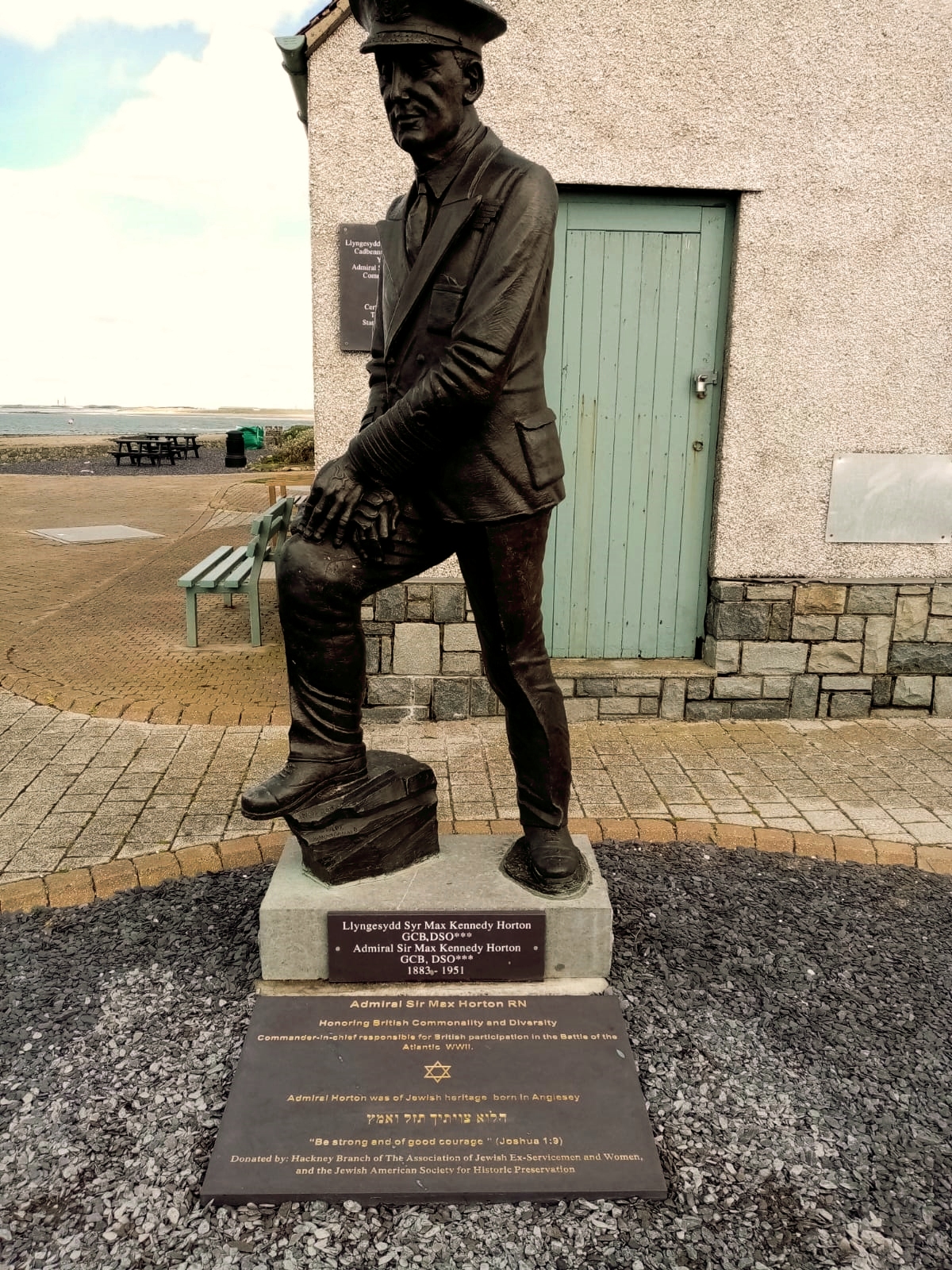
In 2019, a full size sculpture of Horton was funded by the Rhosneigr community and placed in Rhosneigr, where he was born.
Memorial to Sir Max Horton
In 2021 a footstone was funded by the Jewish American Society for Historic Preservation in his honour. The footstone reads, "Admiral Sir Max Horton, RN, Honouring British Commonality and Diversity, Commander-in-Chief responsible for British participation in the Battle of the Atlantic WWII. Admiral Horton was of Jewish heritage born in Anglesey. 'Be strong and of good courage' Joshua 1:9, Donated by the Hackney Branch of the Association of Jewish Ex-Servicemen and Women and the Jewish American Society for Historic Preservation."[10]https://www.sdjewishworld.com/wp-content/uploads/2021/05/Admiral-Horton-with-JASHP-plaque19735.jpg
Distinguished Service Orderand two bars (21 October 1914, highly successful attacks on German men-of-war; 2 November 1917, for long and arduous services in command of overseas submarines; 8 March 1920, distinguished service in command of the Baltic submarine flotilla)
↑Max Horton and the Western Approaches, A biography of Admiral Sir Max Kennedy Horton, G.C.B., D.S.O. By Rear Admiral W.S. Chalmers C.B.E., D.S.C. Hodder and Stoughton, London, 1954, page 3