Definition
Consider a standard regression setting in which the data are fully described by a random pair  with values in
  , and n i.i.d. copies
  of
of  . Regression models aim at finding a good model for the pair, that is a measurable function g from
  to
to  such that
  is close to Y.
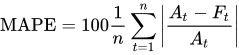
In the classical regression setting, the closeness of to Y is measured via the L2 risk, also called the mean squared error (MSE). In the MAPE regression context,[1] the closeness of to Y is measured via the MAPE, and the aim of MAPE regressions is to find a model  such that:
![{\displaystyle g_{\mathrm {MAPE} }(x)=\arg \min _{g\in {\mathcal {G}}}\mathbb {E} {\Biggl [}\left|{\frac {g(X)-Y}{Y}}\right||X=x{\Biggr ]}}](https://wikimedia.org/api/rest_v1/media/math/render/svg/5d1d5361807456edf90eb56a90450ac09d5964a2)
where  is the class of models considered (e.g. linear models).
In practice
In practice  can be estimated by the empirical risk minimization strategy, leading to

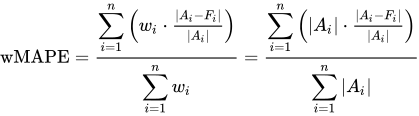
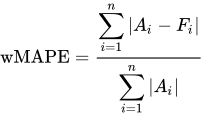
From a practical point of view, the use of the MAPE as a quality function for regression model is equivalent to doing weighted mean absolute error (MAE) regression, also known as quantile regression. This property is trivial since

As a consequence, the use of the MAPE is very easy in practice, for example using existing libraries for quantile regression allowing weights.