The leapfrog integrator can be converted into higher order integrators using techniques due to Haruo Yoshida. In this approach, the leapfrog is applied over a number of different timesteps. It turns out that when the correct timesteps are used in sequence, the errors cancel and far higher order integrators can be easily produced.[6][7]
4th order Yoshida integrator
One step under the 4th order Yoshida integrator requires four intermediary steps. The position and velocity are computed at different times. Only three (computationally expensive) acceleration calculations are required.
The equations for the 4th order integrator to update position and velocity are

where  are the starting position and velocity,
  are intermediary position and velocity at intermediary step
  ,
,  is the acceleration at the position
  , and
, and  are the final position and velocity under one 4th order Yoshida step.
Coefficients 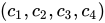 and
and  are derived in [7] (see the equation (4.6))
![{\displaystyle {\begin{aligned}w_{0}&\equiv -{\frac {\sqrt[{3}]{2}}{2-{\sqrt[{3}]{2}}}},&w_{1}&\equiv {\frac {1}{2-{\sqrt[{3}]{2}}}},\\[1ex]c_{1}&=c_{4}\equiv {\frac {w_{1}}{2}},&c_{2}=c_{3}&\equiv {\frac {w_{0}+w_{1}}{2}},\\[1ex]d_{1}&=d_{3}\equiv w_{1},&d_{2}&\equiv w_{0}\\\end{aligned}}}](https://wikimedia.org/api/rest_v1/media/math/render/svg/c2d98d529ed1065719c4cdb2f097d47940f8ab91)
All intermediary steps form one  step which implies that coefficients sum up to one:
  and
and  . Note that position and velocity are computed at different times and some intermediary steps are backwards in time. To illustrate this, we give the numerical values of
  coefficients:
  ,
,  ,
,  ,
, 




![{\displaystyle {\begin{aligned}v_{i+1/2}&=v_{i}+{\tfrac {1}{2}}a_{i}\Delta t,\\[2pt]x_{i+1}&=x_{i}+v_{i+1/2}\Delta t,\\[2pt]v_{i+1}&=v_{i+1/2}+{\tfrac {1}{2}}a_{i+1}\Delta t,\end{aligned}}}](https://wikimedia.org/api/rest_v1/media/math/render/svg/2effc3a9a171feb2f643cc6f7546ed0c2dc652e7)
