Iron-60
Iron-60 has a half-life of 2.62 million years,[14] but was thought until 2009 to have a half-life of 1.5 million years. It undergoes beta decay to 60Co, which then decays with the much shorter half-life of about 5 years to stable 60Ni.
In phases of the meteorites Semarkona and Chervony Kut, a correlation between the excess concentration of 60Ni, the granddaughter isotope of 60Fe, and the abundance of the stable iron isotopes could be found, which is evidence for the existence of 60Fe at the time of formation of the Solar System.[15] Depending on its original abundance, the energy from the decay of 60Fe may have been significant, along with that of 26Al, to the remelting and differentiation of asteroids and planetesimals after their formation. These nickel abundances in extraterrestrial materials may also provide further insight into the origin of the Solar System and its early history.
Live (interstellar) iron-60 was first identified in deep sea sediments in 1999.[16] These are deep sea ferromanganese crusts, which are constantly growing, aggregating iron, manganese, and other elements.[17] Iron-60 has been found in fossilized bacteria in sea floor sediments.[18][19] In 2019, researchers found 60Fe in Antarctica.[20] Iron-60 shows two peaks in deep sea sediments, the first 1.7–3.2 million years ago and the second 6.5–8.7 million years ago. The peaks are related to the passage of the Solar System through the Local Bubble and likely the Orion–Eridanus Superbubble. These superbubbles were created by multiple supernovae.[21] Traces of iron-60 have also been found in lunar samples.
The distance to the supernova of origin can be estimated by relating the amount of iron-60 intercepted as Earth passes through the expanding supernova ejecta. Assuming that the material ejected in a supernova expands uniformly out from its origin as a sphere with surface area 4πr2. The fraction of the material intercepted by the Earth is dependent on its cross-sectional area (πR 2
Earth ) as it passes through the expanding debris:

where Mej is the mass of ejected material. Assuming the intercepted material is distributed uniformly across the surface of the Earth (4πR 2
Earth ), the mass surface density (Σej) of the supernova ejecta on Earth is:

The number of 60Fe atoms per unit area found on Earth can be estimated if the typical amount of 60Fe ejected from a supernova is known. This can be done by dividing the surface mass density (Σej) by the atomic mass of 60Fe.
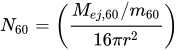
The equation for N60 can be rearranged to find the distance to the supernova.
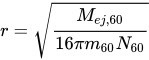
An example calculation for the distance to the supernova point of origin is given below. This calculation uses speculative values for terrestrial 60Fe atom surface density (N60 ≈ 4 × 10¹¹ atoms/m2) and a rough estimate of the mass of 60Fe ejected by a supernova (10×10−5 M☉).

More sophisticated analyses have been reported that take into consideration the flux and deposition of 60Fe as well as possible interfering background sources.[22]
Cobalt-60, the decay product of iron-60, emits 1.173 MeV and 1.332 MeV gamma rays as it decays. These lines have long been important targets for gamma-ray astronomy, and have been detected by the gamma-ray observatory INTEGRAL. The signal traces the Galactic plane, showing that 60Fe synthesis is ongoing in our galaxy, and probing element production in massive stars.[23][24]

