In probability theory, an indecomposable distribution is a probability distribution that cannot be represented as the distribution of the sum of two or more non-constant independentrandom variables: Z≠X+Y. If it can be so expressed, it is decomposable:Z=X+Y. If, further, it can be expressed as the distribution of the sum of two or more independent identically distributed random variables, then it is divisible:Z=X1+…+Xk.
then the probability distribution of X is indecomposable.
Proof: Given non-constant distributions U and V, so that U assumes at least two values a,b and V assumes two values c,d, with a<b and c<d, then U+V assumes at least three distinct values: a+c, a+d, b+d (b+c may be equal to a+d, for example if one uses 0,1 and 0,1). Thus the sum of non-constant distributions assumes at least three values, so the Bernoulli distribution is not the sum of non-constant distributions.
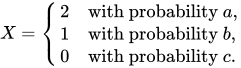
Suppose a+b+c=1, a,b,c≥0, and
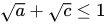
This probability distribution is decomposable (as the distribution of the sum of two Bernoulli-distributed random variables) if
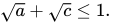
and otherwise indecomposable. To see, this, suppose U and V are independent random variables and U+V has this probability distribution. Then we must have
for some p,q∈[0,1], by similar reasoning to the Bernoulli case (otherwise the sum U+V will assume more than three values). It follows that
This system of two quadratic equations in two variables p and q has a solution (p,q)∈[0,1]2 if and only if
Thus, for example, the discrete uniform distribution on the set {0,1,2} is indecomposable, but the binomial distribution for two trials each having probabilities 1/2, thus giving respective probabilities a, b, c as 1/4,1/2,1/4, is decomposable.
The uniform distribution on the interval [0,1] is decomposable, since it is the sum of the Bernoulli variable that assumes 0 or 1/2 with equal probabilities and the uniform distribution on [0,1/2]. Iterating this yields the infinite decomposition:
where the independent random variables Xn are each equal to 0 or 1 with equal probabilities – this is a Bernoulli trial of each digit of the binary expansion.
A sum of indecomposable random variables is decomposable into the original summands. But it may turn out to be infinitely divisible. Suppose a random variable Y has a geometric distribution
on {0, 1, 2, ...}.
For any positive integer k, there is a sequence of negative-binomially distributed random variables Yj, j = 1, ..., k, each with parameters p and non-integer r=1/k, such that Y1+...+Yk has this geometric distribution. Therefore, this distribution is infinitely divisible.
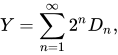
On the other hand, let Dn be the nth binary digit of Y, for n≥ 0. Then the Dn's are independent[why?][citation needed] and
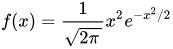
Cramér's theorem shows that while the normal distribution is infinitely divisible, it can only be decomposed into normal distributions.
Cochran's theorem shows that the terms in a decomposition of a sum of squares of normal random variables into sums of squares of linear combinations of these variables always have independent chi-squared distributions.