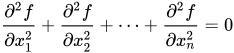
Some important properties of harmonic functions can be deduced from Laplace's equation.
The mean value property
If  is a ball with center
  and radius
  which is completely contained in the open set
  , then the value
  of a harmonic function
  at the center of the ball is given by the average value of
  on the surface of the ball; this average value is also equal to the average value of in the interior of the ball. In other words,
 where
where  is the volume of the unit ball in
  dimensions and
  is the
  -dimensional surface measure.
Conversely, all locally integrable functions satisfying the (volume) mean-value property are both infinitely differentiable and harmonic.
In terms of convolutions, if
 denotes the characteristic function of the ball with radius about the origin, normalized so that
  , the function is harmonic on
  if and only if
 for all and such that
  .
.
Sketch of the proof. The proof of the mean-value property of the harmonic functions and its converse follows immediately observing that the non-homogeneous equation, for any 
 admits an easy explicit solution
  of class
  with compact support in
  . Thus, if is harmonic in
 holds in the set
  of all points in with
Since is continuous in ,  converges to as
  showing the mean value property for in . Conversely, if is any
  function satisfying the mean-value property in , that is,
 holds in for all then, iterating
  times the convolution with
  one has:
 so that is
  because the -fold iterated convolution of is of class
  with support
  . Since and are arbitrary, is
  too. Moreover,
 for all so that
  in by the fundamental theorem of the calculus of variations, proving the equivalence between harmonicity and mean-value property.
This statement of the mean value property can be generalized as follows: If  is any spherically symmetric function supported in such that
  , then
  . In other words, we can take the weighted average of about a point and recover . In particular, by taking to be a
  function, we can recover the value of at any point even if we only know how acts as a distribution. See Weyl's lemma.
Liouville's theorem
Theorem: If  is a harmonic function defined on all of
  which is bounded above or bounded below, then is constant.
(Compare Liouville's theorem for functions of a complex variable).
Edward Nelson gave a particularly short proof of this theorem for the case of bounded functions,[2] using the mean value property mentioned above:
Given two points, choose two balls with the given points as centers and of equal radius. If the radius is large enough, the two balls will coincide except for an arbitrarily small proportion of their volume. Since is bounded, the averages of it over the two balls are arbitrarily close, and so assumes the same value at any two points.
The proof can be adapted to the case where the harmonic function is merely bounded above or below. By adding a constant and possibly multiplying by  , we may assume that is non-negative. Then for any two points and
  , and any positive number
  , we let
  . We then consider the balls
  and
and  where by the triangle inequality, the first ball is contained in the second.
By the averaging property and the monotonicity of the integral, we have
 (Note that since
  is independent of , we denote it merely as
  .) In the last expression, we may multiply and divide by
  and use the averaging property again, to obtain
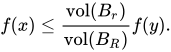 But as
  , the quantity
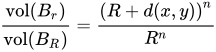 tends to
  . Thus,
  . The same argument with the roles of and reversed shows that
  , so that
  .
.
Another proof uses the fact that given a Brownian motion  in , such that
  , we have
 ![{\displaystyle E[f(B_{t})]=f(x_{0})}](https://wikimedia.org/api/rest_v1/media/math/render/svg/4e4e041d925744c36c7e8761cb60df0eaa0bf22b) for all
for all  . In words, it says that a harmonic function defines a martingale for the Brownian motion. Then a probabilistic coupling argument finishes the proof.[3]















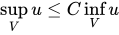





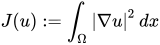




![{\displaystyle D[u]={\frac {1}{2}}\int _{M}\left\|du\right\|^{2}\,d\operatorname {Vol} }](https://wikimedia.org/api/rest_v1/media/math/render/svg/fbbacda9536efc8200c39ac87f74b1d65fbad3cd)


