ENSIKLOPEDIA
Analytic functions
| Mathematical analysis → Complex analysis |
| Complex analysis |
|---|
 |

In mathematical analysis, an analytic function is a function that is locally represented by a convergent power series. More precisely, a real or complex function is analytic at a point if, in some neighborhood of that point, it is equal to a power series centered there. Analytic functions are therefore locally determined by their coefficients, or equivalently by their derivatives at the center of the expansion.
Analytic functions occur in both real analysis and complex analysis, in slightly different ways. A real analytic function is necessarily smooth, but a smooth real function need not be analytic. By contrast, a complex function on an open set is analytic if and only if it is holomorphic, that is, complex differentiable at every point of the set. For this reason, in complex analysis the terms analytic function and holomorphic function are often used interchangeably. The terms complex analytic and real analytic distinguish between these cases.
Analyticity is a strong regularity condition. Analytic functions have rigid local behavior: for example, on a connected domain, an analytic function whose zeros have an accumulation point must vanish identically. Standard examples include polynomials, the exponential function, and the trigonometric functions on their domains of analyticity.
Definitions
Formally, a function 





Alternatively, a real analytic function is an infinitely differentiable function such that the Taylor series at each point 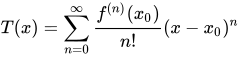


A function
The definition of a complex analytic function is obtained by replacing, in the definitions above, "real" with "complex" and "real line" with "complex plane". A function is complex analytic if and only if it is holomorphic i.e. it is complex differentiable. For this reason the terms "holomorphic" and "analytic" are often used interchangeably for such functions.[1]
In complex analysis, a function is called analytic in an open set 
Examples
Typical examples of analytic functions are
- The following elementary functions:
- All polynomials: if a polynomial has degree
, any terms of degree larger than
- The exponential function is analytic. Any Taylor series for this function converges not only for
- The trigonometric functions are analytic on any open set of their domain.
- The natural logarithm is analytic on any open set where its branch is single-valued, such as
or the complement in the Riemann sphere of any simple arc connecting
to
.
- Power functions are analytic everywhere for non-negative integral powers, away from zero for negative integral powers, and for arbitrary complex powers on any open subset of the complex plane where the logarithm is analytic.
- All polynomials: if a polynomial has degree
- Many special functions are analytic on a suitable domain:
- hypergeometric functions on suitable domains
- Bessel functions on suitable domains
- The gamma function away from its poles at zero and the negative integers
- The Riemann zeta function except for a simple pole at
- Algebraic functions are analytic away from any poles and branch points they may have. Near a branch point, an algebraic function can be represented by a convergent Puiseux series; equivalently, after a change of variable
, it becomes analytic as a function of
.
Typical examples of functions that are not analytic are
- The absolute value function
on the real numbers is not analytic at
on the complex numbers is not complex analytic on any nonempty open subset of
.
- Piecewise defined functions (functions given by different formulae in different regions) are typically not analytic where the pieces meet.
- The complex conjugate function
is not complex analytic, although its restriction to the real line is the identity function and therefore real analytic, and it is real analytic as a function from
to
- Other non-analytic smooth functions, and in particular any smooth function
, cannot be analytic on all of
.[3]
Alternative characterizations
The following conditions are equivalent:
- There is a complex analytic extension of
that contains
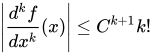
there exists a constant
such that for every
and every non-negative integer
the following bound holds;[4]
Complex analytic functions are exactly equivalent to holomorphic functions, and are thus much more easily characterized.
For the case of an analytic function with several variables (see below), the real analyticity can be characterized using the Fourier–Bros–Iagolnitzer transform.
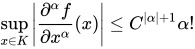
In the multivariable case, real analytic functions satisfy a direct generalization of the third characterization.[5] Let 


Properties of analytic functions
- The sums, products, and compositions of analytic functions are analytic.
- The reciprocal of an analytic function that is nowhere zero is analytic.
- In one variable, the inverse of a one-to-one analytic function whose derivative is nowhere zero is analytic. In several variables, the corresponding condition is that the derivative be an invertible linear map, or equivalently that the Jacobian determinant be nonzero.
- Any analytic function is smooth, that is, infinitely differentiable. The converse is not true for real functions; in fact, in a certain sense, the real analytic functions are sparse compared to all real infinitely differentiable functions. For the complex numbers, the converse does hold: any function with a single complex derivative on an open set is analytic on that set (see § Analyticity and differentiability).
- For any open set
, the set
of all analytic functions
is a Fréchet space with respect to the uniform convergence on compact sets. The fact that uniform limits on compact sets of analytic functions are analytic is an easy consequence of Morera's theorem. The set
of all bounded analytic functions with the supremum norm is a Banach space.
- In contrast, the real analytic functions on an open set are not complete under the topology of uniform convergence on compact subsets, since compact-open limits of real analytic functions need not be real analytic. Real analytic functions are dense in the space of continuous functions in the compact-open topology.
A polynomial cannot be zero at too many points unless it is the zero polynomial (more precisely, the number of zeros is at most the degree of the polynomial). A similar but weaker statement holds for analytic functions. If the set of zeros of an analytic function 


Also, if all the derivatives of an analytic function at a point are zero, the function is constant on the corresponding connected component.
These statements imply that while analytic functions do have more degrees of freedom than polynomials, they are still quite rigid.
Analyticity and differentiability
As noted above, any function (real or complex) is infinitely differentiable on a neighborhood where it is equal to a convergent power series. Thus in a neighborhood of a point of analyticity, there is a convergent power series equal to the function in the neighborhood, and so the function is infinitely differentiable (or smooth) there. There exist smooth real functions that are not analytic: see Non-analytic smooth function. In fact there are many such functions.
The situation is quite different when one considers complex analytic functions and complex derivatives. Any complex-differentiable function (holomorphic function) in an open disc centered at 

Real versus complex analytic functions
Real and complex analytic functions have important differences (one could notice that even from their different relationship with differentiability). Analyticity of complex functions is a more restrictive property, as it has more restrictive necessary conditions and complex analytic functions have more structure than their real-line counterparts.[7]
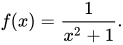
According to Liouville's theorem, any bounded complex analytic function defined on the whole complex plane is constant. The corresponding statement for real analytic functions, with the complex plane replaced by the real line, is clearly false; this is illustrated by
Also, if a complex analytic function is defined in an open ball around a point 


Any real analytic function on some open set on the real line can be extended to a complex analytic function on some open set of the complex plane. However, not every real analytic function defined on the whole real line can be extended to a complex function defined on the whole complex plane. The function 

Taylor series and radius of convergence
If a function is analytic at 


In complex analysis, the radius of convergence of a holomorphic function at a point is the radius of the largest open disc centered at that point on which the function remains holomorphic. In many common cases, this is the distance to the nearest singularity of the function in the complex plane.[13]
This explains the different radii of convergence for familiar Taylor series. The series for 


Complex singularities can determine the radius of convergence even for functions that are smooth on the real line. For example, although
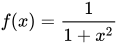


A power series may converge at every point of the boundary of its disc of convergence and still fail to extend holomorphically beyond that disc. For example, if 


Analytic continuation
Because analytic functions are locally represented by power series, a value of the function on one small neighborhood can sometimes determine values on a larger region. This process is called analytic continuation. Starting with a power series representation in one neighborhood, one can then sometimes use this to define the function on overlapping neighborhoods, and continue this process along paths in the domain.
Analytic continuation is unique when it exists on a connected domain. More precisely, if two analytic functions on a connected open set agree on a nonempty open subset, or more generally on a set having an accumulation point in the domain, then they agree everywhere on that connected open set. This is a form of the identity theorem.
However, analytic continuation need not be possible everywhere, and it need not be single-valued. For example, the natural logarithm is locally analytic on 

![{\displaystyle \mathbb {C} \setminus (-\infty ,0]}](https://wikimedia.org/api/rest_v1/media/math/render/svg/176aa07911a31b95347623fb4234598c736029eb)
Algebraic functions give another source of multi-valued analytic continuation. For example, the function 


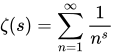
Many special functions are first defined by a power series or an integral formula on a restricted domain and then extended by analytic continuation. For example, the Riemann zeta function is initially defined by the Dirichlet series


Analytic functions of several variables
One can define analytic functions in several variables by means of power series in those variables (see Power series). Analytic functions of several variables have some of the same properties as analytic functions of one variable. However, especially for complex analytic functions, new and interesting phenomena show up in two or more complex dimensions:
- Zero sets of complex analytic functions in more than one variable are never discrete if they are non-empty. This can be proved by Hartogs's extension theorem.
- Domains of holomorphy for single-valued functions consist of arbitrary (connected) open sets. In several complex variables, however, only some connected open sets are domains of holomorphy. The characterization of domains of holomorphy leads to the notion of pseudoconvexity.
Analytic functions over other valued fields
Analogous notions of analyticity can be formulated over other complete valued fields, the real and complex numbers being the two most prominent ones where the absolute value is archimedean. Analytic functions can also be defined over non-Archimedean local fields, such as the p-adic numbers 

If 

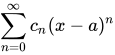
For example, a power series over 


More generally, on the closed disc

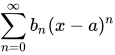


Over a non-Archimedean field the ring of analytic functions on a closed disc is thus related to the Tate algebra, the algebra of power series whose coefficients tend to zero sufficiently fast. This point of view is fundamental in rigid analytic geometry and other forms of non-Archimedean analytic geometry.[26]
See also
Notes
- ↑ This implies uniform convergence as well in a (possibly smaller) neighborhood of
- ↑ Churchill; Brown; Verhey (1948). Complex Variables and Applications. McGraw-Hill. p. 46. ISBN 0-07-010855-2.
A function f of the complex variable z is analytic at point z0 if its derivative exists not only at z but at each point z in some neighborhood of z0. It is analytic in a region R if it is analytic at every point in R. The term holomorphic is also used in the literature to denote analyticity
{{cite book}}: ISBN / Date incompatibility (help) - ↑ Gamelin, Theodore W. (2004). Complex Analysis. Springer. ISBN 9788181281142.
- ↑ Strichartz, Robert S. (1994). A guide to distribution theory and Fourier transforms. Boca Raton: CRC Press. ISBN 0-8493-8273-4. OCLC 28890674.
- ↑ Krantz & Parks 2002, p. 15.
- ↑ Komatsu, Hikosaburo (1960). "A characterization of real analytic functions". Proceedings of the Japan Academy. 36 (3): 90–93. doi:10.3792/pja/1195524081. ISSN 0021-4280.
- ↑ "Gevrey class – Encyclopedia of Mathematics". encyclopediaofmath.org. Retrieved 2020-08-30.
- ↑ Krantz & Parks 2002.
- ↑ Stein & Shakarchi 2003, p. 15 harvnb error: no target: CITEREFSteinShakarchi2003 (help)
- ↑ Freitag & Busam 2005, pp. 111–112 harvnb error: no target: CITEREFFreitagBusam2005 (help)
- ↑ Stein & Shakarchi 2003, p. 15 harvnb error: no target: CITEREFSteinShakarchi2003 (help)
- ↑ Freitag & Busam 2005, pp. 111–112 harvnb error: no target: CITEREFFreitagBusam2005 (help)
- ↑ Freitag & Busam 2005, pp. 112–113, 124 harvnb error: no target: CITEREFFreitagBusam2005 (help)
- ↑ Freitag & Busam 2005, pp. 116–117 harvnb error: no target: CITEREFFreitagBusam2005 (help)
- ↑ Freitag & Busam 2005, p. 53 harvnb error: no target: CITEREFFreitagBusam2005 (help)
- ↑ Freitag & Busam 2005, pp. 113–115 harvnb error: no target: CITEREFFreitagBusam2005 (help)
- ↑ Stein & Shakarchi 2003, pp. 98–100 harvnb error: no target: CITEREFSteinShakarchi2003 (help)
- ↑ Freitag & Busam 2005, pp. 116–117 harvnb error: no target: CITEREFFreitagBusam2005 (help)
- ↑ Freitag & Busam 2005, pp. 116–117 harvnb error: no target: CITEREFFreitagBusam2005 (help)
- ↑ Lang 1999, p. 58 harvnb error: no target: CITEREFLang1999 (help)
- ↑ Freitag & Busam 2005, pp. 29–30, 34 harvnb error: no target: CITEREFFreitagBusam2005 (help)
- ↑ Freitag & Busam 2005, pp. 29–30, 34 harvnb error: no target: CITEREFFreitagBusam2005 (help)
- ↑ Stein & Shakarchi 2003, pp. 73, 98–100 harvnb error: no target: CITEREFSteinShakarchi2003 (help)
- ↑ Ahlfors, Lars V. (1979), Complex analysis (3rd ed.), New York: McGraw-Hill, ISBN 978-0-07-000657-7, Chapter 8.
- ↑ Serre 1979. sfn error: no target: CITEREFSerre1979 (help)
- ↑ Schikhof 1984. sfn error: no target: CITEREFSchikhof1984 (help)
- ↑ Bosch, Güntzer & Remmert 1984. sfn error: no target: CITEREFBoschGüntzerRemmert1984 (help)
References
- Conway, John B. (1978). Functions of One Complex Variable I. Graduate Texts in Mathematics 11 (2nd ed.). Springer-Verlag. ISBN 978-0-387-90328-6.
- Krantz, Steven; Parks, Harold R. (2002). A Primer of Real Analytic Functions (2nd ed.). Birkhäuser. ISBN 0-8176-4264-1.
- Gamelin, Theodore W. (2004). Complex Analysis. Springer. ISBN 9788181281142.
External links
- "Analytic function", Encyclopedia of Mathematics, EMS Press, 2001 [1994]
- Weisstein, Eric W. "Analytic Function". MathWorld.
- Solver for all zeros of a complex analytic function that lie within a rectangular region by Ivan B. Ivanov
| Types by domain, codomain | |
|---|---|
| Classes, properties | |
| Constructions | |
| Generalizations | |

