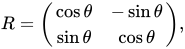
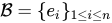
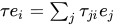
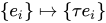
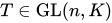
As an active transformation,  transforms the initial vector
 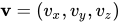 into a new vector
  .
.
If one views  as a new basis, then the coordinates of the new vector
  in the new basis are the same as those of
  in the original basis. Note that active transformations make sense even as a linear transformation into a different vector space. It makes sense to write the new vector in the unprimed basis (as above) only when the transformation is from the space into itself.
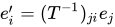
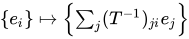
On the other hand, when one views as a passive transformation, the initial vector is left unchanged, while the coordinate system and its basis vectors are transformed in the opposite direction, that is, with the inverse transformation  .[4] This gives a new coordinate system XYZ with basis vectors:

The new coordinates  of
of  with respect to the new coordinate system XYZ are given by:

From this equation one sees that the new coordinates are given by

As a passive transformation transforms the old coordinates into the new ones.
Note the equivalence between the two kinds of transformations: the coordinates of the new point in the active transformation and the new coordinates of the point in the passive transformation are the same, namely